Reliable software is essential for delivering a smooth user experience, protecting business data, and maintaining customer trust. Even a small software defect can interrupt business operations, affect application performance, or create security risks. Software application testing helps identify issues early, verify functionality, and ensure that applications perform as expected before and after release.
Sysinfo provides software application testing services to help businesses improve software quality, reduce defects, validate application functionality, and deliver dependable digital solutions. We support testing throughout the software development lifecycle, from initial requirements and development to deployment and ongoing maintenance.
Whether you are developing a web application, mobile app, enterprise platform, SaaS product, or custom business software, our approach focuses on understanding your requirements, identifying potential risks, and validating the application against real-world usage scenarios.
Our goal is to help your business release software with greater confidence through structured testing, clear reporting, and continuous quality improvement.
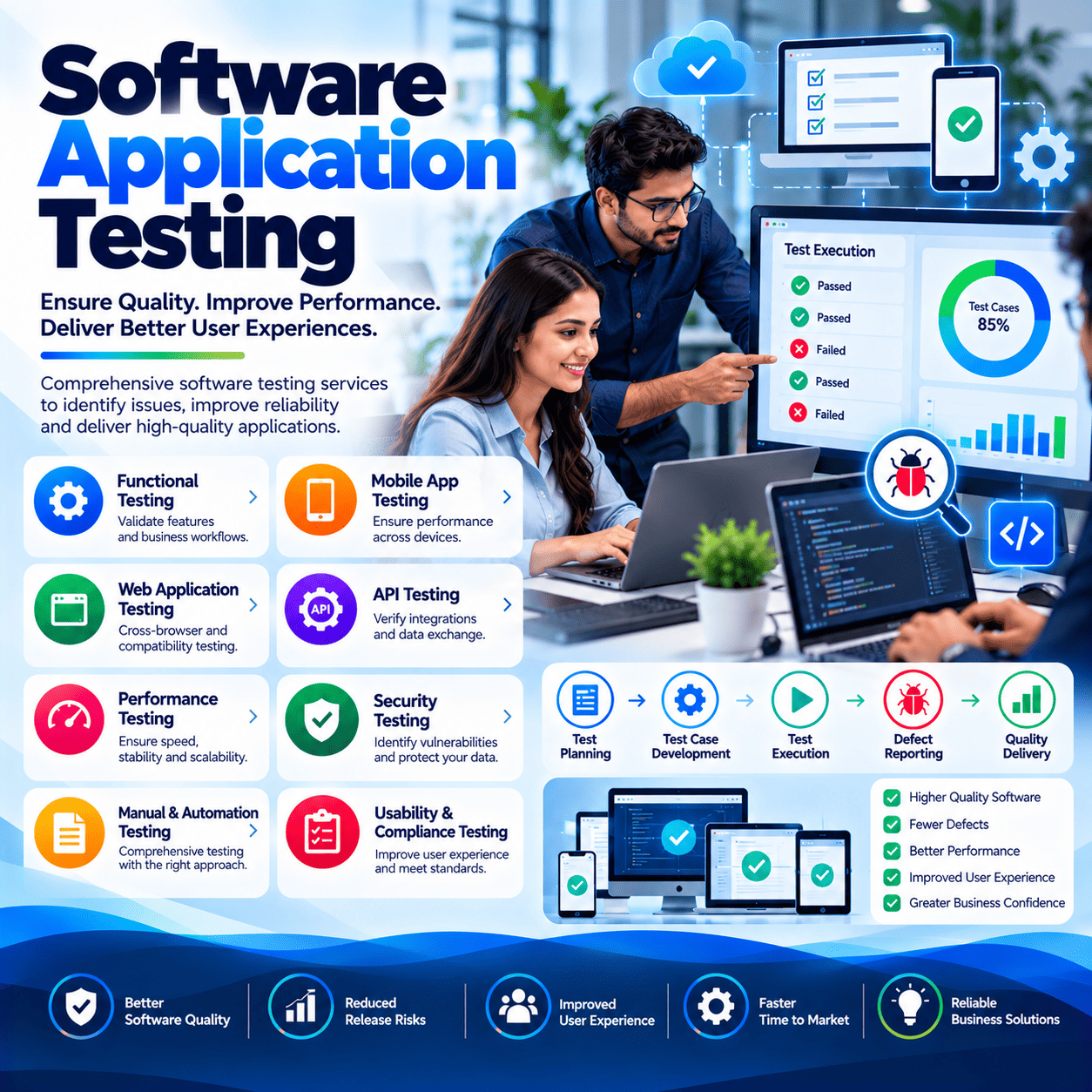
Software application testing is the process of evaluating an application to verify that it meets functional, performance, security, usability, and business requirements. It involves executing test scenarios, identifying defects, validating expected behavior, and confirming that the application is ready for its intended use.
Testing can be performed manually, using automated testing tools, or through a combination of both approaches. The right testing strategy depends on the application’s complexity, technology stack, release schedule, business risks, and quality objectives.
At Sysinfo, we focus on testing that goes beyond checking whether a feature works. We also consider how application components interact, how the system behaves under different conditions, how users experience the interface, and how changes affect existing functionality.
Your software deserves to be secure, reliable, and user‑friendly. With Sysinfo’s Software Application Testing Services, you gain structured workflows, automation, and quality‑focused execution that ensure your applications perform flawlessly.
📞 Contact Sysinfo today to explore how our Software Testing Services can help you deliver applications that users trust and love.
Functional testing verifies that an application behaves according to its specified requirements. It helps confirm that features, workflows, integrations, and business rules work correctly.
Our functional testing services include:
Requirement-based test case development.
User interface and feature validation.
Form and input validation.
Business logic verification.
Authentication and authorization checks.
API and integration testing.
Error message and exception handling validation.
End-to-end business workflow testing.
Defect reporting and retesting.
We test normal scenarios, invalid inputs, boundary conditions, and common user mistakes to help identify issues that may otherwise affect customers or business operations.
Manual testing allows testers to explore application behavior from a user's perspective and evaluate scenarios that may be difficult to automate effectively.
Our manual testing services include:
Exploratory testing.
User journey validation.
Interface and navigation testing.
Business workflow testing.
Cross-browser checks.
Form and validation testing.
Error handling and recovery testing.
Test execution and evidence collection.
Defect documentation and verification.
Manual testing is especially useful for new features, changing requirements, usability assessments, and complex workflows that require human judgment.
Automated testing uses scripts and testing frameworks to execute repeatable test cases and compare actual results with expected outcomes. It is particularly useful for regression testing, frequent releases, and applications with extensive functionality.
Sysinfo can help with:
Automated functional test development.
Regression test automation.
Automated API testing.
Web application test automation.
Reusable test scripts and components.
Automated test execution in CI/CD pipelines.
Test result analysis and reporting.
Maintenance of existing automated test suites.
Identification of suitable automation opportunities.
We prioritize automation where it provides repeatable value, while retaining manual testing for exploratory work and scenarios that need human evaluation.
Web applications must work reliably across supported browsers, screen sizes, devices, and user workflows. Web application testing helps identify functional, compatibility, performance, and interface issues before they affect users.
Our web application testing services include:
Website and web application functionality testing.
Cross-browser compatibility testing.
Responsive layout testing.
Navigation and link validation.
Form submission and input validation.
Session and authentication testing.
API and database interaction validation.
Browser console and client-side error checks.
Web application performance assessment.
Basic security testing and vulnerability identification.
We evaluate applications according to their supported environments and business requirements, helping deliver a more consistent user experience.
Mobile applications must perform reliably across different devices, operating system versions, screen sizes, and network conditions.
Our mobile application testing services can include:
Android application testing.
iOS application testing.
Functional and usability testing.
Device and operating system compatibility checks.
Installation, update, and uninstallation testing.
Network interruption and recovery testing.
Permission and notification validation.
Orientation and screen layout testing.
Mobile API integration testing.
Battery, memory, and responsiveness observations.
Testing priorities are based on the intended audience, supported devices, application features, and release requirements.
An application may function correctly with a few users but experience delays or failures when traffic increases. Performance testing helps evaluate responsiveness, stability, scalability, and resource utilization under defined workloads.
Our performance testing services include:
Load testing under expected traffic.
Stress testing beyond normal operating conditions.
Spike testing for sudden traffic increases.
Endurance testing over extended periods.
Response time and throughput measurement.
Database and API performance assessment.
Resource utilization analysis.
Bottleneck identification.
Performance test reporting and recommendations.
We help businesses understand how applications respond under specific workloads and identify areas that may need optimization. Actual performance depends on infrastructure, configuration, application design, and workload characteristics.
Security testing helps identify weaknesses that could expose sensitive information, compromise user accounts, or affect application integrity. It is an important part of building software that businesses and customers can trust.
Our security testing services can include:
Authentication and authorization testing.
Role-based access control validation.
Session management testing.
Input validation and injection testing.
Secure API testing.
Sensitive data exposure checks.
Configuration and security header reviews.
Dependency vulnerability assessment.
Common web application vulnerability testing.
Security defect reporting and retesting.
Security testing is conducted within an agreed scope and authorization. Where deeper penetration testing or specialist security assessments are required, the scope should be defined with appropriately qualified security professionals.
APIs connect applications, services, databases, and third-party platforms. API testing verifies that these connections exchange information correctly and handle invalid requests, errors, and security restrictions appropriately.
Our API testing services include:
REST API testing.
Request and response validation.
HTTP status code verification.
Authentication and authorization checks.
Schema and data type validation.
Positive and negative test scenarios.
Error response testing.
Integration and workflow testing.
API performance testing.
Automated API regression testing.
We help verify that APIs behave consistently, enforce expected access rules, and communicate errors in a predictable way.
Regression testing checks whether recent code changes, bug fixes, configuration updates, or new features have affected existing functionality.
Our regression testing services include:
Regression test suite planning.
Existing feature validation.
Critical business workflow testing.
Integration regression testing.
Cross-browser regression checks.
Automated regression test implementation.
Risk-based test selection.
Defect verification after fixes.
Regression testing within release pipelines.
A well-planned regression strategy helps teams identify unintended side effects before changes reach production.
Modern applications depend on multiple components working together. Integration testing verifies the communication and data exchange between these components.
We test integrations involving:
Front-end and back-end systems.
APIs and microservices.
Databases and application services.
Payment gateway integrations.
Authentication providers.
Third-party applications.
Enterprise systems and business platforms.
Message queues and asynchronous workflows.
External data sources.
Our approach focuses on data consistency, interface contracts, error handling, and recovery behavior when connected systems do not respond as expected.
User Acceptance Testing helps confirm whether an application supports the intended business processes and meets agreed acceptance criteria. It gives business stakeholders an opportunity to validate the solution before final approval.
Our UAT support can include:
Business requirement review.
Acceptance criteria preparation.
Real-world business scenario development.
Test environment coordination.
User acceptance test execution support.
Defect and feedback tracking.
Business stakeholder coordination.
Acceptance status reporting.
Retesting after corrections.
We help organize UAT so business users can evaluate the application against practical needs rather than technical requirements alone.
Users access applications through different browsers, devices, operating systems, and screen sizes. Compatibility testing helps identify differences that may affect functionality or presentation.
Our services include:
Testing across supported browsers.
Browser version compatibility checks.
Desktop and mobile layout validation.
Operating system compatibility testing.
Screen resolution and responsive layout checks.
Device-specific behavior validation.
Font, image, and rendering checks.
Input and interaction compatibility testing.
Testing coverage is selected according to your target audience, supported platforms, and application requirements.
A software application should be easy to navigate, understandable, and usable by its intended audience. Usability and accessibility testing help identify obstacles that affect how people interact with the application.
Our testing activities can include:
Navigation and information flow assessment.
Form usability checks.
Readability and interface consistency reviews.
Keyboard navigation testing.
Focus visibility checks.
Accessible form labels and error messages.
Color contrast checks.
Screen reader compatibility checks for selected workflows.
Responsive interaction testing.
Recommendations for improving the user experience.
Accessibility testing can be aligned with applicable guidelines such as the Web Content Accessibility Guidelines (WCAG), based on the project's requirements and intended conformance level.
Database testing helps verify that information is stored, retrieved, updated, and processed correctly. It is particularly important for applications that depend on accurate records and reliable transactions.
Our database testing services include:
Data integrity and consistency checks.
Database CRUD operation testing.
Query result validation.
Stored procedure and function testing.
Transaction and rollback validation.
Data migration verification.
Relationship and constraint checks.
Data synchronization testing.
Backup and recovery validation support.
We focus on identifying data-related defects that may affect application functionality, reporting, or business operations.
Effective quality assurance starts with a clear strategy. QA consulting helps businesses establish testing practices that fit their development process, risk profile, and delivery goals.
Sysinfo can support:
QA process assessment.
Test strategy and test plan development.
Risk-based testing recommendations.
Test case design and documentation.
Test automation feasibility assessment.
Defect lifecycle and reporting guidelines.
Quality metrics definition.
Release readiness criteria.
Testing process improvement.
QA integration with Agile and DevOps workflows.
We help businesses create a repeatable quality assurance process rather than relying only on testing at the end of development.
Sysinfo follows a structured testing process designed to identify issues early, provide actionable feedback, and support confident software releases.
Understand application functionality, business objectives, user journeys, technical dependencies, and acceptance criteria.
Define testing scope, priorities, environments, tools, responsibilities, risks, and expected deliverables.
Prepare test scenarios covering expected behavior, invalid inputs, boundary conditions, integrations, and critical workflows.
Configure suitable environments, test accounts, datasets, browsers, devices, and application versions.
Perform the agreed manual, automated, functional, integration, compatibility, performance, or security testing activities.
Document identified issues with reproduction steps, expected behavior, actual results, evidence, and priority recommendations.
Validate corrections and confirm whether reported defects have been resolved.
Check related functionality to identify unintended effects caused by recent changes.
Summarize test execution, coverage, pass and fail results, unresolved defects, and outstanding risks.
Compare the results with agreed acceptance criteria and communicate remaining risks to the responsible stakeholders.
We align test scenarios with business requirements, user expectations, and acceptance criteria so testing addresses the right problems.
We prioritize critical workflows and high-impact defects based on application risks and business needs.
Combine manual testing, automation, API validation, and performance checks according to your application’s requirements.
Document defects with reproducible steps, expected and actual results, supporting evidence, and severity or priority recommendations.
Regression testing and repeatable checks help teams validate changes as applications evolve.
We tailor the testing approach to your application’s architecture, programming languages, frameworks, and deployment environment.
Testing reports summarize coverage, execution results, unresolved defects, risk areas, and recommended next steps.

Choosing the right Oracle solution can provide your business with a strong foundation for managing data and enterprise applications.
Identify defects and unexpected behavior before they affect users.
Validate navigation, functionality, responsiveness, and usability.
Check critical workflows and high-impact areas before deployment.
Evaluate response times, throughput, and behavior under defined workloads.
Identify potential application weaknesses through appropriately scoped security testing.
Provide clear defect details to support investigation and correction.
Use regression testing to check that existing functionality continues to work.
Validate that application workflows meet requirements and acceptance criteria.
Use defined test exit criteria and reporting to support release decisions.
Use test results and defect trends to improve development and testing practices.
Sysinfo can tailor application testing to different business models and technical environments.
Validate appointment workflows, patient-facing features, forms, and authorized data handling.
Validate APIs, integrations, subscriptions, permissions, and frequent application releases.
Test transaction workflows, access controls, data integrity, and critical business rules.
Evaluate complex workflows, role-based access, data exchange, and compatibility with connected systems.
Validate product listings, shopping carts, checkout flows, payment integrations, and order processing.
Validate product listings, shopping carts, checkout flows, payment integrations, and order processing.
Test student portals, enrollment workflows, online learning features, and assessment functionality.
Testing requirements vary by industry, so scope should be agreed according to business priorities and any applicable regulatory obligations.
Software application testing services evaluate whether software functions correctly, meets business requirements, performs reliably, and handles expected usage conditions. Depending on the project, testing may include functional, manual, automated, API, performance, security, and compatibility testing.
Testing helps identify defects before they affect users, validates important business workflows, and provides evidence about application quality. It also helps teams understand release risks and make better-informed deployment decisions.
Manual testing involves a tester executing scenarios and evaluating results directly. Automated testing uses scripts and tools to execute repeatable checks. Manual testing is useful for exploratory and usability-focused work, while automation is particularly valuable for regression testing and frequent releases.
Yes, an existing application can be assessed and tested based on its available requirements, functionality, architecture, and access arrangements. Testing can focus on reported defects, new features, integrations, regression risks, or broader quality improvements.
Testing can cover web applications, mobile applications, enterprise software, SaaS platforms, APIs, e-commerce systems, and custom business applications. The scope depends on the application's technology and the required testing coverage.
Regression testing checks whether existing functionality continues to work after code changes, bug fixes, upgrades, or configuration updates. It helps identify unintended side effects before an application is released.
Yes. Automated tests can be connected to continuous integration and delivery pipelines to run during builds, pull requests, or release stages. Teams can use the results as quality gates, with rules appropriate to the application's risks and delivery requirements.
The timeline depends on application complexity, testing scope, number of platforms, test data availability, integrations, and defect severity. A focused feature test may take considerably less time than a full application assessment or performance testing engagement.
Depending on the agreed scope, deliverables may include a test plan, test cases, execution results, defect reports, automation scripts, performance findings, test coverage summaries, and a final testing report with outstanding risks.
No. Testing can reduce risk and improve confidence, but it cannot prove that every possible defect has been identified. Effective quality assurance combines appropriate testing coverage, sound engineering practices, monitoring, and continuous improvement.
Quality assurance focuses on improving the processes used to develop and deliver software. Software testing evaluates the application to identify defects and verify expected behavior. Testing is an important part of a broader quality assurance strategy.
Start by sharing your application type, technology stack, testing challenges, and release objectives. Sysinfo can help define a suitable testing scope, identify priorities, and outline an approach based on your project requirements.
Copyright © 2026 Sysinfo Solutions