Successful software development is not just about choosing the right programming language. It requires the right engineering methodology, architecture, collaboration, automation, and continuous improvement.
At Sysinfo, we combine proven software development methodologies with modern engineering practices to help businesses build reliable, scalable, and future-ready applications. From Agile and Scrum development to AI-assisted software engineering, cloud-native development, microservices architecture, and DevOps automation, our capabilities support every stage of the software development lifecycle.
Whether you are developing a new application, modernizing an existing platform, or improving your software delivery process, we help you explore practical engineering approaches aligned with your business objectives.
Our focus is simple: Build quality software, simplify development, and support continuous business growth.
CTA: Explore Our Engineering Services | Discuss Your Project

Explore our software engineering capabilities and discover how modern development practices can support your technology goals.
Modern businesses need applications that can handle changing workloads, support faster releases, integrate with multiple systems, and remain reliable as the business grows.
Software development doesn’t end when the code is written. Applications need to be tested, deployed, monitored, secured, and continuously improved.
AI-assisted software development helps businesses build, test, improve, and maintain software more efficiently by combining experienced developers with artificial intelligence.
Choosing the right development methodology and engineering approach can influence product quality, delivery efficiency, scalability, and long-term maintenance.
At Sysinfo, we focus on applying suitable engineering practices based on your application requirements, technical environment, and business goals.
We use relevant development approaches and engineering practices to support maintainable, reliable, and scalable software.
We work with structured and iterative approaches based on project complexity, priorities, and delivery requirements.
We help plan and implement architectures that can accommodate changing workloads, additional features, and future business needs.
We support automated development, testing, integration, and deployment workflows to improve consistency and release management.
We consider testing, code quality, security, and maintainability throughout the development lifecycle.
We encourage clear communication, regular feedback, and alignment between technical teams and business stakeholders.
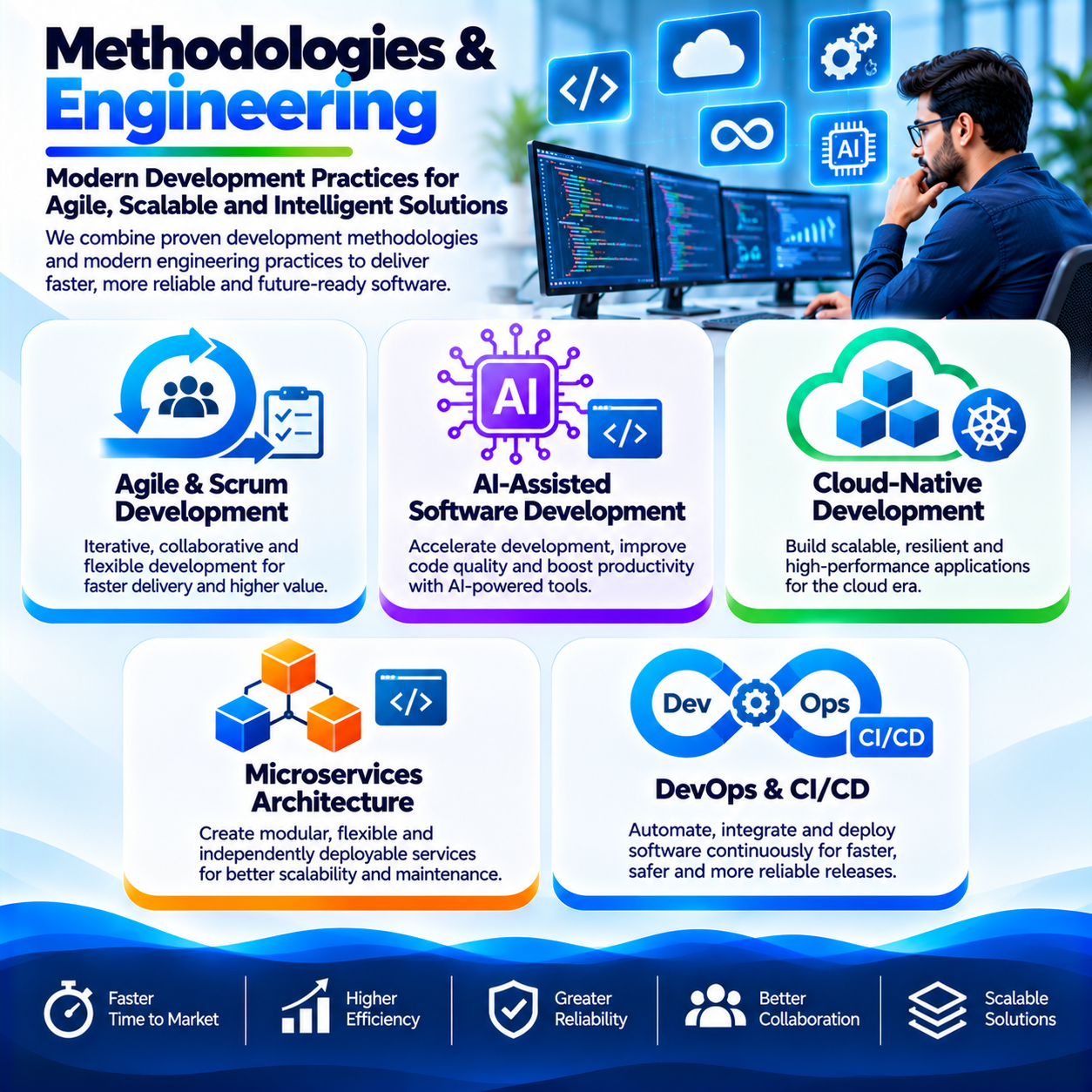
Every project has different technical and business requirements. We select suitable methodologies and engineering practices based on the nature of the application, team structure, delivery expectations, and long-term objectives.
We begin by understanding your business goals, existing applications, technical challenges, and expected outcomes.
We review relevant architecture, technology platforms, development workflows, integrations, and operational requirements.
We identify suitable development and collaboration practices, whether that involves Agile and Scrum, structured delivery, or a combination of approaches.
We plan the application architecture, development workflows, automation opportunities, and implementation priorities.
We implement the agreed solution and carry out appropriate testing and integration activities to support quality and reliability.
We support the agreed release process and identify opportunities for ongoing optimization, maintenance, and improvement.
Modern software engineering practices can support businesses across a wide range of industries and application types.
Our methodologies and engineering capabilities may be relevant to:
Software product development companies
SaaS businesses and technology startups
Banking and financial technology
Healthcare and enterprise systems
Retail and ecommerce platforms
Education and learning management systems
Manufacturing and industrial applications
Enterprise business applications
Cloud-based digital platforms
The appropriate methodology and architecture depend on each organization’s technical environment, compliance requirements, and business priorities.
Modern software engineering requires more than individual tools or technologies. It requires the right combination of development methodologies, architecture, automation, and engineering practices.
Whether you want to introduce Agile development, explore AI-assisted coding, build cloud-native applications, adopt microservices, or improve your CI/CD pipelines, Sysinfo can discuss the right approach for your business.
Let’s connect and explore how modern methodologies and engineering practices can support your next software development project.
CTA: Contact Sysinfo | Discuss Your Requirements | Request a Consultation
Sysinfo – Modern Engineering. Smarter Development. Better Business Outcomes.
Software development methodologies are structured approaches used to plan, organize, develop, test, and maintain software applications. Examples include Agile, Scrum, and other project delivery approaches.
Agile is a broader set of principles and values focused on iterative development, collaboration, and responding to change. Scrum is a framework within the Agile ecosystem that organizes work into sprints, defined responsibilities, events, and product backlogs.
AI-assisted software development uses artificial intelligence tools to support activities such as code suggestions, debugging, documentation, testing, and development workflow automation. Engineers remain responsible for reviewing and validating the output.
Cloud-native development is an approach to designing and building applications for cloud environments. It may use containers, orchestration, automation, distributed services, and managed cloud technologies to support flexible application deployment and scaling.
Microservices architecture organizes an application into smaller services that communicate through defined interfaces. Each service focuses on a specific business capability and can be developed and deployed independently when appropriate.
A monolithic application typically groups major application functionality within one deployable unit. A microservices application separates functionality into multiple services that can be managed and deployed independently. The best approach depends on application complexity and operational needs.
DevOps combines development and IT operations practices to improve collaboration, automation, software delivery, and application management throughout the development lifecycle.
CI/CD stands for Continuous Integration and Continuous Delivery or Deployment. It uses automated workflows to integrate code changes, run tests, and prepare or release software updates more consistently.
Yes. These approaches can complement one another. Agile supports iterative planning, DevOps supports automated delivery and operations, and cloud-native practices support applications designed for cloud environments. Their implementation should be tailored to the project.
Sysinfo can discuss your existing development process, technical environment, and business requirements to identify suitable approaches involving Agile, AI-assisted engineering, cloud-native development, microservices, and DevOps automation.
Copyright © 2026 Sysinfo Solutions