AI-assisted software development helps businesses build, test, improve, and maintain software more efficiently by combining experienced developers with artificial intelligence. From AI coding assistants and automated testing to intelligent code reviews and AI-enabled engineering workflows, the right approach can help development teams reduce repetitive work, improve code quality, and deliver software faster.
Sysinfo provides AI-assisted software development services to help businesses introduce practical AI capabilities into their software engineering processes. We help teams adopt AI coding tools, streamline testing, automate development tasks, improve developer productivity, and integrate AI responsibly into existing workflows.
Our focus is not simply on generating code with AI. It is on helping your team use AI to solve real engineering challenges while maintaining human oversight, security, maintainability, and software quality.
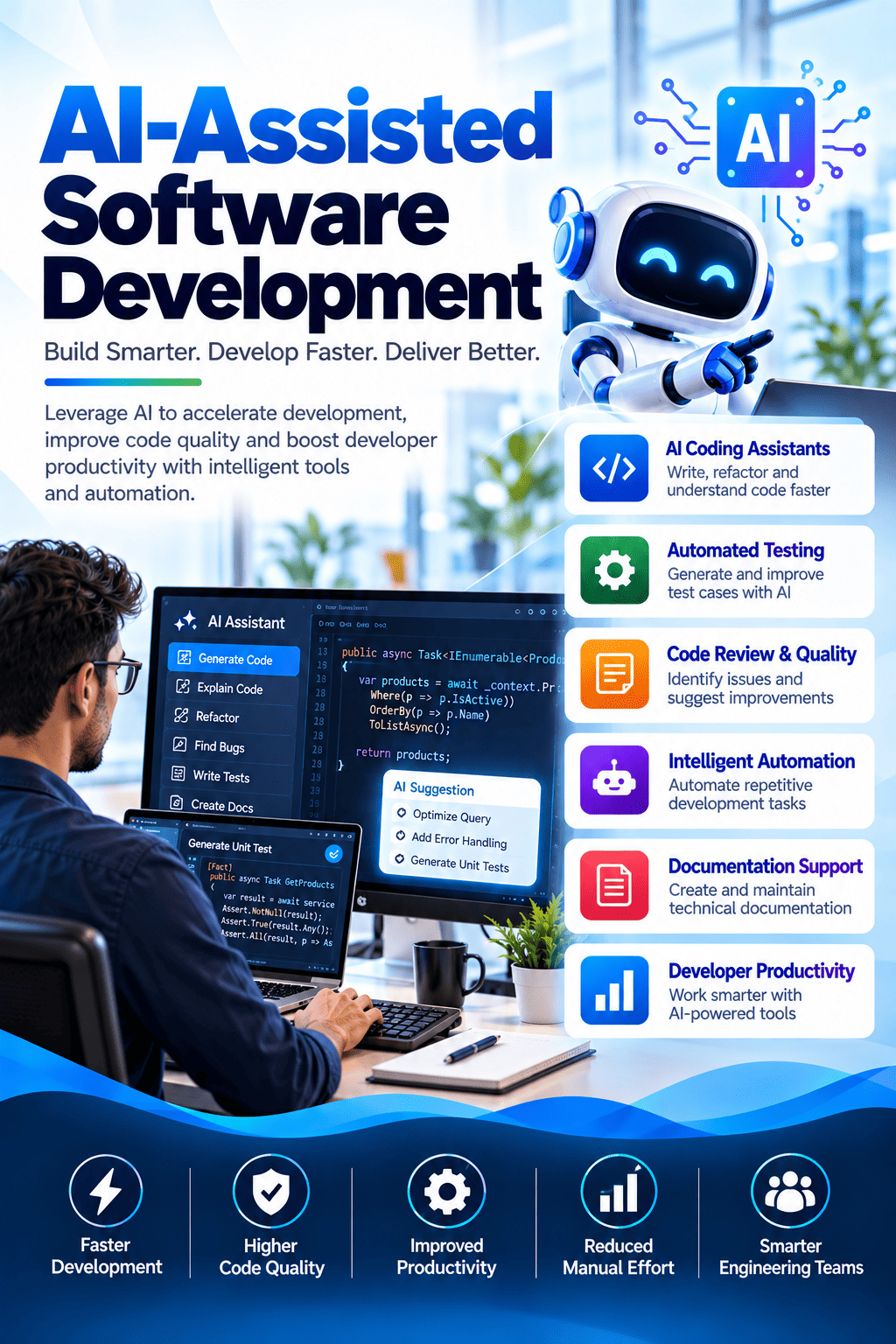
AI-assisted software development is the practice of using artificial intelligence tools throughout the software development lifecycle to support coding, debugging, testing, documentation, code review, and engineering operations.
Instead of replacing developers, AI tools act as intelligent assistants that help engineers explore solutions, understand complex code, generate repetitive code, identify potential defects, and complete routine tasks more efficiently. Developers remain responsible for validating suggestions, making architectural decisions, and ensuring the final software meets business and technical requirements.
Microsoft’s current guidance for development and testing in DevSecOps identifies AI as a development accelerator, alongside reusable components and automated testing. It also emphasizes the importance of governed AI adoption, security checks, and integrated engineering workflows.
Sysinfo helps businesses integrate AI into their development workflows based on their technology stack, project requirements, team capabilities, and security needs.
Help developers write and understand code with AI-powered coding assistants integrated into their preferred development environments.
Our services include:
AI coding assistant evaluation and setup.
Context-aware code completion and code generation.
Natural-language prompts for functions, classes, and application components.
Code explanation and assistance with unfamiliar codebases.
Refactoring suggestions and repetitive-code reduction.
Developer guidelines for reviewing and validating AI-generated code.
Team onboarding and practical usage guidance.
We help teams choose suitable tools and establish consistent practices so AI-generated suggestions align with project standards. GitHub Copilot and Visual Studio AI capabilities are examples of tools that can support these workflows.
Software quality depends on testing that is repeatable, relevant, and closely connected to development. AI can assist teams in creating test scenarios and identifying areas that require additional coverage.
Our services include:
AI-assisted unit test generation.
Integration test development and enhancement.
Test case suggestions from requirements and user stories.
Edge-case identification and negative testing scenarios.
Regression test improvement.
Test data preparation using privacy-conscious practices.
Test failure analysis and debugging assistance.
Integration of automated tests into CI/CD pipelines.
AI-generated tests must be reviewed and executed like other tests. Our approach combines AI assistance with established testing practices to help teams improve coverage without treating generated tests as proof of correctness.
Code reviews help teams maintain consistency, identify defects, and make software easier to maintain. AI can provide an additional layer of review by highlighting potential issues and suggesting improvements.
Sysinfo can help introduce workflows for:
Identifying duplicated or unnecessarily complex code.
Reviewing naming conventions and coding standards.
Suggesting refactoring opportunities.
Highlighting potential defects and error-handling gaps.
Checking maintainability and readability.
Supporting pull request summaries and change explanations.
Flagging potential security concerns for human review.
Applying consistent review checklists across projects.
AI review suggestions should complement—not replace—peer reviews, static analysis, security testing, and engineering judgment.
Debugging can consume considerable development time, especially in large applications or systems with many dependencies. AI-assisted workflows can help developers understand error messages, investigate possible causes, and explore corrective actions.
Our services include:
Error-log and stack-trace interpretation.
Potential root-cause analysis.
Suggestions for bug reproduction steps.
Assistance with debugging unfamiliar code.
Analysis of likely failure points.
Recommendations for targeted fixes.
Regression test suggestions after defect resolution.
Documentation of recurring problems and resolutions.
Developers validate each proposed fix against the application's actual behavior to avoid introducing new defects or masking underlying issues.
AI can help engineers spend less time on repetitive tasks and more time on architecture, business logic, and problem-solving.
We help teams identify and streamline activities such as:
Generating code templates and boilerplate.
Creating documentation from reviewed code.
Summarizing pull requests and code changes.
Drafting technical explanations for complex modules.
Assisting with API usage and implementation examples.
Improving code navigation and knowledge discovery.
Preparing release notes and change summaries.
Supporting developer onboarding and knowledge transfer.
The objective is to improve the development experience while keeping code quality, accountability, and maintainability at the center of the process.
Documentation can become outdated when software changes frequently. AI-assisted workflows can help teams create, review, and maintain useful technical documentation.
Our services include:
API documentation assistance.
Code comments and function descriptions.
Architecture and module summaries.
README and setup-guide preparation.
Technical documentation updates after code changes.
Knowledge-base search and summarization.
Documentation support for legacy applications.
Developer onboarding materials.
Generated documentation is checked against the actual code and system behavior before publication, helping reduce misleading or outdated technical information.
AI can support routine engineering activities across issue tracking, code repositories, testing, and release management.
Sysinfo helps businesses evaluate and implement automation for:
Converting well-defined requirements into development task drafts.
Summarizing issues and pull requests.
Suggesting task classifications and priorities.
Automating repetitive repository activities.
Assisting with build and test failure summaries.
Preparing release documentation.
Connecting AI tools to approved engineering systems.
Creating human approval steps for important or sensitive actions.
Automation can range from simple assistant-driven tasks to more advanced agent-supported workflows. Access permissions, approval requirements, logging, and rollback options should match the risk of each action.
Older applications often contain complex business rules, limited documentation, and tightly connected components. AI can assist engineers in understanding these systems before changes are made.
Our services include:
Legacy code explanation and summarization.
Identification of duplicated logic.
Refactoring recommendations.
Assistance with migration planning.
Test generation for existing functionality.
API and dependency analysis.
Documentation of legacy modules.
Support for incremental modernization.
We use a controlled, step-by-step approach so modernization decisions are validated against existing behavior and business requirements rather than relying on automatically generated changes alone.
AI adoption must not create new security, privacy, or intellectual-property risks. We help integrate AI into software engineering with practical controls that support secure development.
Our services include:
AI tool and usage-policy assessment.
Guidance on sensitive data and source-code handling.
Secure coding review practices.
Static analysis and dependency scanning integration.
Human review of AI-generated code.
Secret and credential protection practices.
Permission controls for AI integrations.
Auditability and review of automated actions.
Integration with existing DevSecOps processes.
Microsoft's DevSecOps guidance emphasizes governing development accelerators such as AI, incorporating security into development and testing, and moving toward more continuous validation.
AI-assisted engineering can complement established DevOps processes when integrated with build, test, deployment, and monitoring workflows.
We help teams explore:
AI-generated pipeline configuration drafts.
Build and deployment failure summaries.
Test-result analysis.
Release-note generation.
Deployment-readiness checklists.
Assistance with infrastructure-as-code reviews.
Incident and log summarization.
Controlled AI integration with approved DevOps tools.
Critical deployment, production access, and security decisions should retain the appropriate approvals and policy checks. AI can help prepare and analyze changes, while established pipeline controls determine what can be released.
AI coding tools can help developers implement API endpoints, application components, integrations, and repetitive service patterns.
Our services can include:
API implementation assistance.
Request and response model generation.
Validation and error-handling suggestions.
API documentation and example generation.
Integration test support.
Database access code assistance.
Code consistency checks across application layers.
Refactoring of repeated implementation patterns.
Generated code is checked against API contracts, authorization rules, performance requirements, and project-specific coding standards before use.
Successful AI adoption requires more than enabling a coding assistant. Teams need clear use cases, suitable tools, consistent guidelines, and a way to measure whether the change improves their work.
Sysinfo can support your organization with:
Current development workflow assessment.
AI use-case identification and prioritization.
Tool selection and pilot planning.
Development standards and prompt guidance.
Secure usage policies.
Developer enablement and knowledge sharing.
Workflow integration planning.
Productivity and quality measurement.
Continuous improvement recommendations.
We help businesses start with practical, measurable use cases and expand adoption as their engineering processes mature.
Sysinfo follows a structured approach to introduce AI into software engineering while keeping business requirements, quality, and security in focus.
Review the existing application, programming languages, repositories, testing practices, development tools, and recurring engineering challenges.
Prioritize suitable tasks such as code generation, debugging assistance, test creation, documentation, and workflow automation.
Evaluate coding assistants, integrated development environment (IDE) features, testing tools, and automation options based on compatibility, privacy, governance, and cost.
Establish guidance for source-code sharing, sensitive information, approved tools, code review, intellectual-property considerations, and human approval.
Introduce AI assistance to a selected project or development team before expanding it across the organization.
Connect AI-assisted development with unit tests, integration tests, code analysis, dependency checks, and existing quality gates.
Integrate approved AI capabilities into repositories, pull requests, issue tracking, CI/CD pipelines, and documentation processes where appropriate.
Compare relevant indicators such as task completion time, review effort, test coverage, defect trends, and developer feedback against a baseline.
Help teams use AI effectively, write clear prompts, verify suggestions, recognize limitations, and follow project-specific standards.
Refine the workflows based on observed results, emerging risks, and changing business requirements before expanding successful practices.
This incremental approach aligns with Microsoft’s recommendation to assess current engineering practices, identify priorities, and improve development and security capabilities progressively.
We connect AI capabilities to actual development challenges, project objectives, and business priorities instead of adding tools without a clear purpose.
AI workflows are designed to support developers in their existing environments, repositories, and engineering practices.
We emphasize approved tools, appropriate data handling, access controls, and human review for sensitive or high-impact changes.
AI assistance can be connected to coding, testing, documentation, code review, and delivery activities where it provides practical value.
AI-generated code and tests remain subject to appropriate validation, automated checks, and engineering review.
We tailor AI-assisted workflows to your application’s language, framework, development environment, and delivery pipeline.
We help teams evaluate adoption, identify friction, and refine their workflows based on practical feedback and measurable outcomes.
The specific tools depend on your application, existing subscriptions, architecture, and business requirements.
Technology area |
Examples |
|---|---|
AI coding assistants
|
GitHub Copilot, Visual Studio AI capabilities, IntelliCode
|
Development environments
|
Visual Studio, Visual Studio Code, JetBrains IDEs
|
Programming languages
|
C#, .NET, Java, JavaScript, TypeScript, Python
|
Application frameworks
|
ASP.NET Core, Spring Boot, React, Node.js
|
Automated testing
|
xUnit, NUnit, JUnit, Jest, Playwright
|
Code quality and security
|
SonarQube, CodeQL, static analysis, dependency scanning
|
Source control
|
Git, GitHub, GitLab, Azure Repos
|
CI/CD and DevOps
|
GitHub Actions, Azure Pipelines, Jenkins, GitLab CI/CD
|
Cloud platforms
|
Microsoft Azure, AWS, Google Cloud
|
Workflow automation
|
APIs, approved AI integrations, scripts, and engineering workflow tools
|
Tool availability, features, and integrations vary by product version, license, and configuration. We recommend selecting tools based on verified requirements rather than adopting every available AI feature.

Choosing the right Oracle solution can provide your business with a strong foundation for managing data and enterprise applications.
Reduce time spent on repetitive coding, documentation, and routine engineering tasks.
Use AI assistance for implementation drafts, code exploration, and common development activities.
Generate test ideas and improve automated test coverage where appropriate.
Make complex modules and unfamiliar codebases easier to investigate.
Streamline recurring activities across code reviews, issue management, and release preparation.
Make technical explanations and project documentation easier to create and maintain.
Combine AI-assisted reviews with automated tests and security analysis to identify potential problems earlier.
Help developers understand project conventions, architecture, and existing implementation patterns.
Use AI assistance to explore alternatives while leaving technical decisions with the responsible team.
Introduce repeatable workflows with appropriate access controls and human oversight.
AI can make software engineering more efficient when it is introduced with clear goals, reliable quality checks, and the right balance between automation and human expertise.
Whether you want to introduce AI coding assistants, improve automated testing, modernize legacy applications, or streamline engineering workflows, Sysinfo can help you plan a practical AI-assisted software development approach aligned with your team’s needs.
Ready to explore AI-assisted software development for your business? Contact Sysinfo to discuss your application, development challenges, and opportunities for responsible AI adoption.
Use AI coding assistants to support C# implementation, API development, unit test creation, refactoring, debugging, and technical documentation. Combine these capabilities with established .NET coding standards and security checks.
Support Java developers with code explanations, service implementation, test generation, API documentation, debugging, and refactoring across Spring Boot applications.
Use AI to help developers understand legacy code, document business rules, identify repeated logic, prepare migration plans, and create regression tests before making significant changes.
Support faster feature development, test creation, pull request summaries, documentation, and consistent development practices across product teams.
Use AI assistance to summarize build failures, explain pipeline errors, draft configuration changes, prepare release notes, and improve routine engineering workflows while retaining deployment controls.
Use AI to help generate test ideas, expand edge-case coverage, summarize failures, and identify areas that need additional testing. Keep test execution and acceptance criteria grounded in actual application behavior.
AI-assisted software development services help businesses integrate AI into coding, debugging, testing, documentation, code review, and engineering workflows. The goal is to improve developer efficiency while preserving software quality and human oversight.
AI can suggest code, explain unfamiliar functions, help identify bugs, draft unit tests, assist with refactoring, and generate documentation. Developers review the results and decide whether the suggestions are suitable for their application.
AI can generate useful code drafts and implementation suggestions, but the output is not automatically production-ready. It should be reviewed, tested, checked for security issues, and validated against the application's requirements before deployment.
Yes. AI tools can support existing applications by helping developers understand legacy code, improve documentation, identify refactoring opportunities, write tests, and investigate defects. Access to the relevant code and project context determines how useful the assistance will be.
No. AI is best treated as an engineering assistant. Developers continue to make architectural decisions, understand business requirements, review generated code, validate security, and take responsibility for the final software.
Yes. AI can assist with test case suggestions, unit test drafts, edge-case identification, failure analysis, and test maintenance. Tests must still be executed and evaluated against clear acceptance criteria.
It can be implemented with appropriate safeguards, but security is not automatic. Organizations should establish approved-tool policies, protect confidential information, apply access controls, review generated code, and integrate security testing into development workflows.
Options include GitHub Copilot and AI capabilities within development environments such as Visual Studio. The right choice depends on programming languages, IDE compatibility, enterprise policies, data-handling requirements, licensing, and integration needs.
Businesses can track task completion time, code review effort, test coverage, defect trends, build failures, documentation effort, and developer feedback. Comparing results with a baseline helps distinguish meaningful improvements from assumptions.
Sysinfo can help assess your development workflow, identify suitable AI use cases, evaluate tools, establish usage guidelines, integrate AI into selected engineering activities, and measure results. The implementation approach is tailored to your technology stack and business objectives.
Copyright © 2026 Sysinfo Solutions