Modern software development requires more than writing code and delivering a product at the end of a long project. Business requirements change, customer expectations evolve, and new opportunities can appear during development. Agile development and Scrum methodology help software teams respond to these changes while maintaining a clear focus on business value.
At Sysinfo, we use Agile and Scrum principles to make software development more collaborative, transparent, and adaptable. Instead of waiting until the end of a project to deliver results, we break development into manageable iterations, prioritize the most valuable work, gather continuous feedback, and improve the product throughout the development lifecycle.
Our Agile development approach is designed for businesses that want faster delivery, better visibility, continuous improvement, customer-focused development, and flexible project management.
Agile development is a software development approach that focuses on iterative delivery, collaboration, customer feedback, adaptability, and continuous improvement.
Rather than defining every detail at the beginning and following a rigid plan for months, Agile teams work in shorter development cycles. Each cycle produces measurable progress that can be reviewed, tested, and improved.
This approach allows businesses to:
Agile does not mean developing without a plan. It means creating a flexible plan that can adapt as the project becomes clearer.
Scrum is one of the most widely used Agile frameworks for managing software development.
A Scrum project is divided into short development cycles called Sprints. During each Sprint, the team selects a prioritized set of work, develops and tests the features, reviews the results, and uses feedback to plan the next iteration.
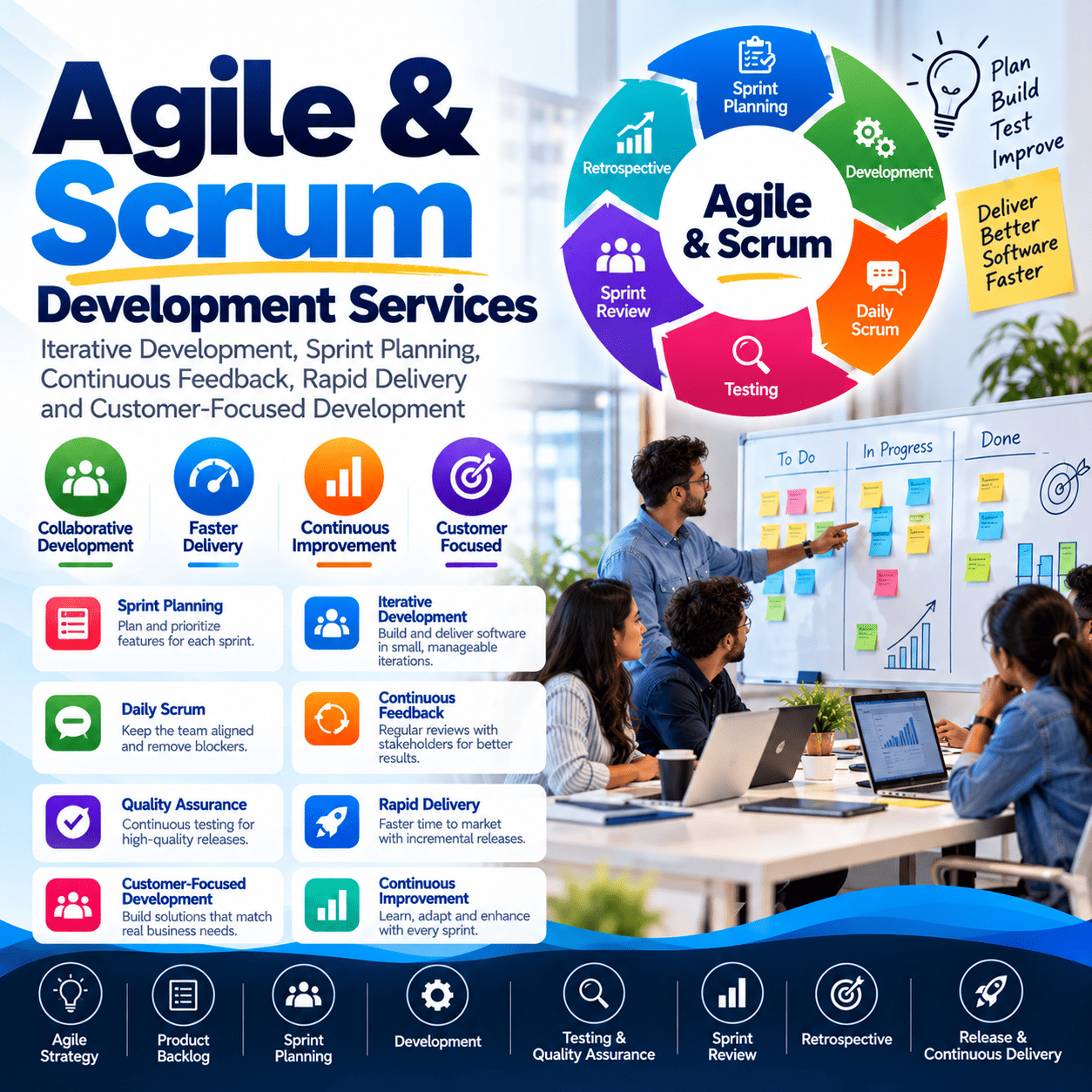
A typical Scrum workflow includes:
Product Backlog → Sprint Planning → Sprint Development → Daily Scrum → Testing → Sprint Review → Retrospective → Next Sprint
This creates a continuous cycle of planning, development, feedback, and improvement.
We help businesses develop software using Agile principles that encourage continuous delivery and adaptation.
Our Agile development process can support:
The development process is divided into manageable iterations so stakeholders can review progress regularly.
Our Scrum-based development process provides a structured framework for managing software projects.
We can help establish:
Scrum provides visibility into what is being developed, what has been completed, what is currently being worked on, and what needs attention.
Sprint planning is an important part of successful Scrum development.
Before each Sprint, the team reviews the prioritized Product Backlog and determines which items can realistically be completed.
Our sprint planning process considers:
This helps teams maintain realistic Sprint commitments rather than trying to complete too much work at once.
The Product Backlog contains the features, improvements, technical work, fixes, and other requirements that may be needed for the product.
We help organize and prioritize backlog items according to business value and technical importance.
Backlog management can include:
A well-managed backlog helps the team focus on the work that matters most.
User stories help translate business requirements into understandable development tasks.
A typical user story focuses on:
Who needs something → What they need → Why they need it
For example:
As an online customer, I want to track my order so that I can see its current delivery status.
We can help define user stories along with:
This helps developers, testers, business stakeholders, and customers maintain a common understanding of the requirement.
Instead of attempting to build the entire application at once, we develop the product in smaller increments.
Each iteration can include:
This makes it easier to identify problems early and adjust the product before significant resources are invested in the wrong direction.
Daily Scrum meetings help development teams stay aligned.
The team can discuss:
The goal is not simply to report activity. It is to identify obstacles and keep the team moving toward the Sprint Goal.
Testing is integrated into the development process rather than being postponed until the end of the project.
Our Agile QA approach can include:
Continuous testing helps identify defects earlier and reduces the risk of major issues appearing close to release.
At the end of a Sprint, completed work can be demonstrated to stakeholders.
Sprint reviews provide an opportunity to:
This creates a direct feedback loop between development teams and business stakeholders.
A Sprint Retrospective focuses on improving the way the team works.
The team can discuss:
The purpose is not to assign blame. It is to help the team become more effective in future Sprints.
Agile development can support frequent and controlled software releases.
We can help businesses plan releases around:
For suitable projects, Agile development can also be combined with DevOps and CI/CD automation to streamline software delivery.
We apply Agile practices across different types of software projects, including:
Agile development can help businesses build web applications through incremental feature releases and continuous feedback.
Mobile applications can be developed through prioritized releases, usability testing, and continuous improvements based on user feedback.
For large enterprise applications, Agile practices can help coordinate development across multiple teams and business functions.
SaaS products benefit from frequent releases, customer feedback, continuous improvement, and flexible prioritization.
Agile methods can be used to continuously improve shopping experiences, payment workflows, product management, checkout processes, and customer features.
Cloud-based applications can be developed and released incrementally while incorporating DevOps, monitoring, automation, and scalability requirements.
We begin by understanding your business objectives, users, existing systems, project goals, technical requirements, and expected outcomes.
We establish a clear understanding of what the product needs to achieve and who it is intended to serve.
Requirements are organized into features, user stories, technical tasks, improvements, and other work items.
The backlog is prioritized according to business value, customer impact, technical dependencies, risks, and release objectives.
The team selects realistic work for the upcoming Sprint and establishes a clear Sprint Goal.
Developers work on the selected features while following agreed coding, architecture, security, and quality practices.
QA activities take place alongside development to identify and resolve issues as early as possible.
Completed work is demonstrated to stakeholders and feedback is collected.
The team reviews its working process and identifies practical improvements for the next Sprint.
The cycle continues until the product reaches its release objectives, followed by ongoing enhancements and maintenance as required.
Turn support conversations into meaningful interactions that guide users, build trust, and encourage confident decisions.
Ensure customer data remains secure with advanced protection, compliance-ready infrastructure, and scalable security controls.
We focus on delivering software that solves real business problems rather than simply completing technical tasks.
Agile development provides regular visibility into project progress, upcoming work, completed features, and potential blockers.
By prioritizing high-value features, businesses can start benefiting from important functionality earlier in the development lifecycle.
Business requirements can change. Agile allows teams to reassess priorities and adapt future development based on new information.
Regular reviews help ensure the product continues to match customer and stakeholder expectations.
Frequent development and testing cycles make it easier to identify technical, functional, and usability problems earlier.
Continuous testing, reviews, and feedback help improve software quality throughout development.
Our Agile approach works together with modern development technologies such as .NET, ASP.NET Core, Java, Spring Boot, APIs, cloud platforms, databases, containers, and DevOps tools.
Retrospectives and regular project reviews allow teams to improve development practices throughout the project.
Our involvement can continue beyond the initial product release with maintenance, enhancement, modernization, and ongoing development.
Turn support conversations into meaningful interactions that guide users, build trust, and encourage confident decisions.
Ensure customer data remains secure with advanced protection, compliance-ready infrastructure, and scalable security controls.
Depending on the project, our Agile development process can incorporate:
We don’t apply Agile mechanically. We adapt the process to the size, complexity, team structure, and business requirements of each project.
Successful software development is not simply about delivering features. It is about building the right features, learning from real users, responding to changing requirements, and continuously improving the product.
At Sysinfo, our Agile and Scrum development approach combines structured planning with the flexibility businesses need in a changing technology environment. From Sprint planning and user stories to iterative development, continuous testing, customer feedback, release planning, and ongoing improvement, we help create a development process that keeps the project moving while maintaining focus on business value.
Whether you are building a new application, developing a SaaS product, modernizing an enterprise system, or improving an existing platform, Sysinfo can help you implement a practical Agile development strategy tailored to your project.
Contact Sysinfo today to discuss your Agile & Scrum development requirements and start building software through a faster, more collaborative, and customer-focused development process.

Choosing the right Oracle solution can provide your business with a strong foundation for managing data and enterprise applications.
Agile development focuses on delivering usable functionality in smaller increments rather than waiting for the entire product to be completed.
New information, customer feedback, and changing business priorities can be incorporated into future Sprints.
Testing and validation are integrated throughout the development process.
Stakeholders can regularly see what has been completed and what is planned next.
Frequent reviews make it easier to discover problems before they become expensive to fix.
Regular feedback keeps the product aligned with actual user and business needs.
Developers, testers, business stakeholders, product owners, and other participants work together throughout the development lifecycle.
The team focuses on the most important features first instead of spending equal effort on every requirement.
Retrospectives provide opportunities to improve processes, communication, quality, and productivity.
Agile allows the product roadmap to evolve as the market, customer needs, and business priorities change.
Agile development can be particularly valuable for startups and growing companies because the product direction may change as customers begin using the application.
Instead of investing heavily in a complete product before receiving market feedback, businesses can:
This allows development resources to remain focused on features that provide meaningful value.
Agile is also useful for large organizations managing complex applications and multiple development teams.
Enterprise Agile development can help with:
For larger projects, Agile practices can be adapted to coordinate dependencies and maintain visibility across teams.
Our Agile development workflow can integrate with commonly used project and development tools, including:
The specific tools are selected according to your existing environment and project requirements.
A successful Scrum implementation depends on clearly understood responsibilities.
The Product Owner represents business and customer priorities and helps manage the Product Backlog.
The Scrum Master helps the team follow Scrum practices, removes impediments, and supports effective collaboration.
Developers and technical specialists design, build, integrate, and improve the product.
QA professionals validate functionality, quality, performance, usability, and other project requirements.
Stakeholders provide business context, feedback, validation, and product direction.
Depending on the project structure, Sysinfo can work alongside your internal Product Owner and stakeholders or provide appropriate project and technical support.

Agile software development is an iterative approach where software is developed in smaller increments, reviewed regularly, and improved continuously based on feedback and changing requirements.
Scrum is an Agile framework that organizes development into short cycles called Sprints. It uses practices such as Sprint Planning, Daily Scrum, Sprint Review, and Sprint Retrospective.
A Sprint is commonly one to four weeks long. The appropriate duration depends on the product, team, release cycle, and business requirements.
Not necessarily. Agile works particularly well when requirements may evolve, frequent feedback is valuable, and incremental delivery is beneficial. We assess the project before recommending an Agile or Scrum approach.
Agile is a broader approach based on principles for iterative and adaptive development. Scrum is a specific framework that provides roles, events, artifacts, and practices for implementing Agile development.
Agile can help reduce certain project risks by delivering and testing work incrementally, gathering feedback regularly, and identifying problems earlier rather than waiting until the end of the project.
Yes. Agile and Scrum are development methodologies rather than programming languages. They can be used for .NET, ASP.NET Core, Java, Spring Boot, mobile, cloud, API, SaaS, and other software projects.
Yes. After the initial release, we can continue working on new features, bug fixes, performance improvements, modernization, integrations, security updates, and other product enhancements through an ongoing development cycle.
Copyright © 2026 Sysinfo Solutions