Software development doesn’t end when the code is written. Applications need to be tested, deployed, monitored, secured, and continuously improved. When these activities rely heavily on manual work, releases can become slow, deployment errors can increase, and development teams may spend more time managing processes than delivering new features.
Sysinfo provides DevOps and CI/CD services that help businesses automate software delivery, improve collaboration, and build reliable development and deployment workflows. We bring development, quality assurance, infrastructure, security, and operations practices together to create a more consistent software delivery process.
Our DevOps approach covers the complete application lifecycle, from source code management and continuous integration to automated testing, infrastructure as code, continuous delivery, production monitoring, and ongoing optimization. These practices align with Microsoft’s guidance on modern DevOps, which emphasizes collaboration, automation, continuous delivery, infrastructure as code, and monitoring.
Whether you are developing a new web application, modernizing an enterprise platform, deploying cloud-native applications, or improving an existing release process, Sysinfo helps you establish a DevOps workflow that fits your business and technical requirements.
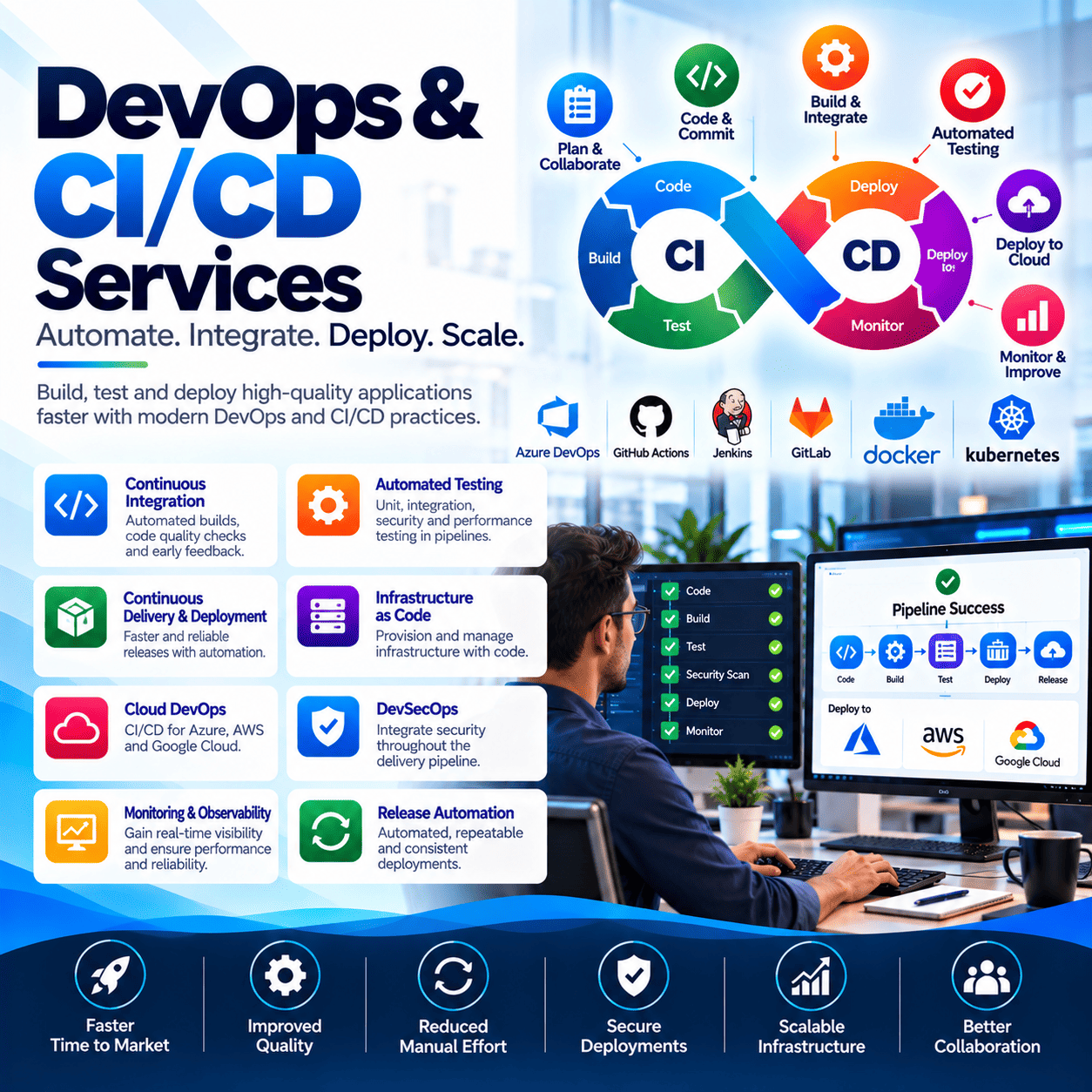
Every organization has different development processes, infrastructure, release schedules, and operational challenges. Our DevOps consulting services help identify opportunities to improve the way software is built, tested, released, and maintained.
Our services include:
Assessment of existing development and deployment workflows
DevOps strategy and implementation planning
Development and operations process alignment
Source control and branching strategy
Build and release automation
Environment management
Deployment risk assessment
Workflow standardization
Toolchain selection and integration
Continuous improvement planning
We focus on practical improvements that support your development team rather than introducing unnecessary tools or processes.
Continuous Integration allows developers to merge code changes into a shared repository frequently. Automated build and test processes then help identify problems before they reach later stages of development.
Sysinfo can help implement CI pipelines that include:
Automated application builds
Source code integration
Pull request validation
Unit testing
Integration testing
Code quality checks
Dependency validation
Build artifact generation
Pipeline failure notifications
Version control integration
Continuous integration helps teams detect defects earlier, receive faster feedback, and maintain a more reliable codebase.
Continuous Delivery keeps tested software ready for release through an automated and controlled delivery process. Continuous Deployment goes a step further by automatically releasing qualifying changes to production when the required checks pass.
Our CI/CD services can include:
Automated release pipelines
Development, testing, staging, and production environments
Environment-specific configuration
Deployment approvals
Release gates
Artifact promotion
Database migration workflows
Deployment verification
Rollback planning
Release notifications
Production deployment automation
We configure delivery workflows around your release requirements. Production deployments can include manual approval stages where business controls or regulatory requirements make them necessary.
Manual testing remains valuable for exploratory testing and usability assessment, but repeating every test manually can slow development.
We integrate automated testing into development and CI/CD workflows to help teams identify defects earlier and release changes with greater confidence.
Our automated testing services include:
Unit test automation
Integration test automation
API testing
Functional testing
Regression testing
Browser-based testing
Performance testing
Security testing
Test result reporting
Quality gates within CI/CD pipelines
Automated testing can reduce repetitive work and provide consistent validation. The appropriate level of automation depends on application complexity, test coverage, and business risk.
Infrastructure as Code enables teams to define infrastructure through version-controlled configuration files instead of relying entirely on manual setup.
Sysinfo can help automate the provisioning and management of cloud and application environments.
Our IaC services include:
Infrastructure template development
Cloud resource provisioning
Network and environment configuration
Development and testing environment automation
Version-controlled infrastructure
Infrastructure validation
Configuration management
Environment replication
Infrastructure change reviews
Automated infrastructure deployment
Depending on the project, we can work with technologies such as Terraform, Azure Bicep, Azure Resource Manager templates, and configuration automation tools.
IaC helps make infrastructure deployments more repeatable, reviewable, and consistent across environments.
Cloud environments provide many opportunities for automation, but applications still require reliable deployment processes, security controls, configuration management, and monitoring.
Our cloud DevOps services support organizations building or operating applications on:
Microsoft Azure
Amazon Web Services (AWS)
Google Cloud Platform (GCP)
Services can include cloud deployment pipelines, environment automation, resource configuration, container deployment, access management, release management, and operational monitoring.
We work with your existing cloud environment wherever possible and recommend changes based on actual project needs.
Releasing software reliably requires more than a working pipeline. Teams need clear release procedures, environment controls, approvals, and recovery plans.
Our release management services include:
Release workflow design
Version management
Artifact management
Deployment scheduling
Release approvals
Environment promotion
Deployment health checks
Rollback planning
Release documentation
Production readiness checks
Where appropriate, we can implement safer deployment techniques such as rolling deployments, blue-green deployment, or canary releases.
For businesses using Microsoft technologies, Azure DevOps provides integrated capabilities for source control, work tracking, build automation, testing, and delivery.
Our Azure DevOps services include:
Azure Repos configuration
Azure Pipelines implementation
YAML pipeline development
Build and release automation
Azure Boards workflow integration
Git repository management
Automated testing integration
Deployment approvals
Azure environment deployment
Release management
Pipeline troubleshooting and optimization
We can build Azure DevOps workflows for .NET, ASP.NET Core, Java, APIs, and other application stacks.
GitHub Actions allows development teams to automate software workflows directly from their GitHub repositories.
Our services include:
GitHub Actions workflow development
CI pipeline configuration
Automated test execution
Container image builds
Package publishing
Cloud deployment automation
Environment protection rules
Secret management
Pull request checks
Release workflows
Workflow troubleshooting
We can also integrate GitHub Actions with cloud platforms, container registries, testing frameworks, and deployment environments.
Containers package an application and its dependencies into a consistent deployment unit, helping reduce differences between development, testing, and production environments.
Our containerization and deployment services include:
Dockerfile development
Container image optimization
Multi-stage builds
Docker Compose configuration
Container registry integration
Container image versioning
Automated image builds
Container security checks
Environment configuration
Container deployment pipelines
Containerization is especially useful for modern web applications, APIs, microservices, and cloud-native systems.
For applications that require container orchestration, Kubernetes can help manage deployments, scaling, application health, and service communication.
Our Kubernetes DevOps services include:
Kubernetes deployment configuration
Cluster deployment automation
Application rollout pipelines
Kubernetes manifests and Helm charts
Environment-specific configuration
Health checks
Scaling configuration
Container registry integration
Deployment monitoring
Rolling updates
Rollback procedures
We support managed Kubernetes environments such as Azure Kubernetes Service (AKS), Amazon EKS, and Google Kubernetes Engine (GKE), according to project requirements.
Security should be part of the software delivery process, not a final check performed immediately before release.
Our DevSecOps services integrate security practices into source control, development, testing, infrastructure, and deployment workflows.
Our capabilities can include:
Static application security testing (SAST)
Software dependency scanning
Secret detection
Container image scanning
Infrastructure as Code scanning
Secure build pipelines
Access control
Credential and secret management
Security approval gates
Vulnerability remediation workflows
The exact checks depend on the application's architecture, data sensitivity, compliance obligations, and risk profile. Integrating these controls into delivery pipelines can help identify security issues earlier.
A successful deployment is only one part of delivering reliable software. Teams also need visibility into application health, infrastructure performance, errors, and user-facing problems.
Sysinfo can help establish monitoring and observability workflows that include:
Application performance monitoring
Infrastructure monitoring
Centralized logging
Metrics collection
Distributed tracing
Application health checks
Alert configuration
Error tracking
Operational dashboards
Deployment health verification
Incident investigation support
We can integrate suitable monitoring tools, including Azure Monitor and other cloud-native or third-party platforms.
These capabilities help teams detect problems, understand their impact, and improve application reliability over time.
Legacy applications can be difficult to build, test, deploy, and maintain when they rely on manual processes or outdated infrastructure.
We help organizations modernize their delivery workflows alongside application improvements.
This may involve:
Migrating manual builds into automated pipelines
Introducing Git-based source control
Automating regression tests
Containerizing applications
Modernizing deployment scripts
Automating cloud infrastructure
Improving environment consistency
Integrating monitoring
Introducing security checks
Supporting gradual migration to modern architectures
The goal is to improve delivery reliability without requiring every legacy application to be rewritten at once.
As applications evolve, pipelines can become slow, unreliable, or difficult to maintain. Regular reviews help keep the delivery process aligned with changing requirements.
Our ongoing support services include:
CI/CD pipeline troubleshooting
Build failure investigation
Pipeline performance optimization
Test execution improvements
Deployment issue resolution
Infrastructure configuration updates
Toolchain integration
Access and permissions reviews
Monitoring and alert improvements
Documentation and knowledge transfer
We help teams maintain a more predictable software delivery process as projects and workloads grow.
We review your development process, source control, testing practices, infrastructure, deployment procedures, monitoring, and existing tools.
We identify the improvements that matter most to your business, such as reducing deployment effort, improving release consistency, increasing test coverage, or strengthening security.
We plan the pipeline stages, environments, source control workflow, testing strategy, artifact management, approvals, and deployment requirements.
We establish repository workflows and configure automated builds, code validation, and the creation of deployable artifacts.
We incorporate appropriate unit, integration, API, functional, regression, and security tests into the pipeline.
Where appropriate, we use Infrastructure as Code and configuration automation to make environment provisioning more consistent and repeatable.
We configure deployment stages, environment promotion, approvals, deployment verification, and recovery procedures.
We incorporate suitable security checks, logging, metrics, alerts, and application health monitoring.
We test the pipeline from code changes through build, testing, deployment, and post-deployment verification.
After implementation, we review pipeline performance, resolve issues, update configurations, and improve the workflow as requirements evolve.
We assess your existing workflow before recommending improvements. Our focus is on solving real delivery problems, not adding complexity for its own sake.
We can connect source control, build automation, testing, artifact management, release approvals, deployment, and monitoring into a coordinated workflow.
Automating suitable manual tasks helps teams spend less time on routine deployment activities and more time on application development and improvement.
We support DevOps workflows for .NET, ASP.NET Core, Azure, Azure DevOps, Azure Pipelines, and GitHub Actions, while considering other technologies when appropriate.
Our DevOps approach can incorporate cloud infrastructure, Docker, Kubernetes, microservices, and managed cloud services where they fit the application.
We help incorporate automated testing and quality checks into the pipeline so that issues can be identified before deployment.
We consider security checks, credentials, permissions, dependencies, and infrastructure configuration throughout development and delivery.
Standardized pipelines and infrastructure definitions can reduce configuration differences and make deployments easier to reproduce.
Monitoring, logs, metrics, and alerts provide useful information about application behavior and help teams investigate production issues.
We can help improve existing pipelines, resolve deployment issues, and adapt DevOps processes as your application and team evolve.
Sysinfo can work with a suitable combination of tools based on your development stack, cloud platform, and existing infrastructure.
Git, GitHub, GitLab, Bitbucket, Azure Repos
Azure Pipelines, Azure DevOps, GitHub Actions, Jenkins, GitLab CI/CD
Terraform, Azure Bicep, ARM templates, configuration management tools
Docker, Kubernetes, Helm, AKS, Amazon EKS, Google Kubernetes Engine
Microsoft Azure, Amazon Web Services (AWS), Google Cloud Platform (GCP)
.NET, ASP.NET Core, Java, Spring Boot, Node.js, Python, REST APIs
Unit testing frameworks, API testing tools, browser automation, performance testing and code quality analysis
Azure Monitor, cloud monitoring services, centralized logging, metrics, distributed tracing and alerting
Automate builds, tests, package creation, and deployments for .NET and ASP.NET Core applications. Integrate with Azure, containers, databases, and monitoring tools as required.
Create CI/CD workflows for Java and Spring Boot applications, including automated testing, package management, container builds, and cloud deployment.
Support containerized applications and microservices with automated builds, Kubernetes deployments, infrastructure automation, health checks, and observability.
Standardize build and release processes across enterprise applications, integrations, databases, and multiple deployment environments.
Support frequent product updates through automated testing, controlled releases, environment management, monitoring, and deployment validation.
Introduce automation gradually to older applications, starting with source control, repeatable builds, automated tests, or deployment improvements where feasible.

Choosing the right Oracle solution can provide your business with a strong foundation for managing data and enterprise applications.
Automated build, test, and deployment workflows can reduce repetitive manual steps and help teams release software more efficiently.
Continuous integration and automated testing provide feedback on code changes before they progress further through the delivery process.
Standardized pipelines help reduce differences between environments and make deployment procedures more repeatable.
Automation reduces reliance on repetitive manual configuration and release tasks, although pipelines still require validation and monitoring.
DevOps encourages development, testing, security, and operations teams to work toward shared delivery and reliability goals.
Automated tests, deployment checks, approval stages, and rollback plans can make software releases more controlled.
Infrastructure as Code makes it easier to provision, review, reproduce, and update environments as application requirements change.
Security checks integrated into development and deployment workflows can help teams identify vulnerabilities earlier.
Monitoring and logging help teams understand application health, deployment outcomes, errors, and infrastructure performance.
Pipeline metrics, deployment feedback, incidents, and team reviews provide opportunities to improve delivery processes over time.
A reliable software delivery process helps businesses release improvements with greater consistency while maintaining control over quality, security, and operational stability.
Sysinfo provides DevOps and CI/CD services that bring together continuous integration, automated testing, continuous delivery, Infrastructure as Code, deployment automation, monitoring, and security practices. Whether you need to establish your first CI/CD pipeline, modernize an existing deployment workflow, or improve cloud-native application delivery, we can help you create a practical solution around your technical environment.
From Azure DevOps and GitHub Actions to Docker, Kubernetes, Terraform, automated testing, and cloud monitoring, our focus is on making software delivery more repeatable, transparent, and maintainable.
Contact Sysinfo to discuss your DevOps requirements and build a more efficient, secure, and reliable software delivery process.
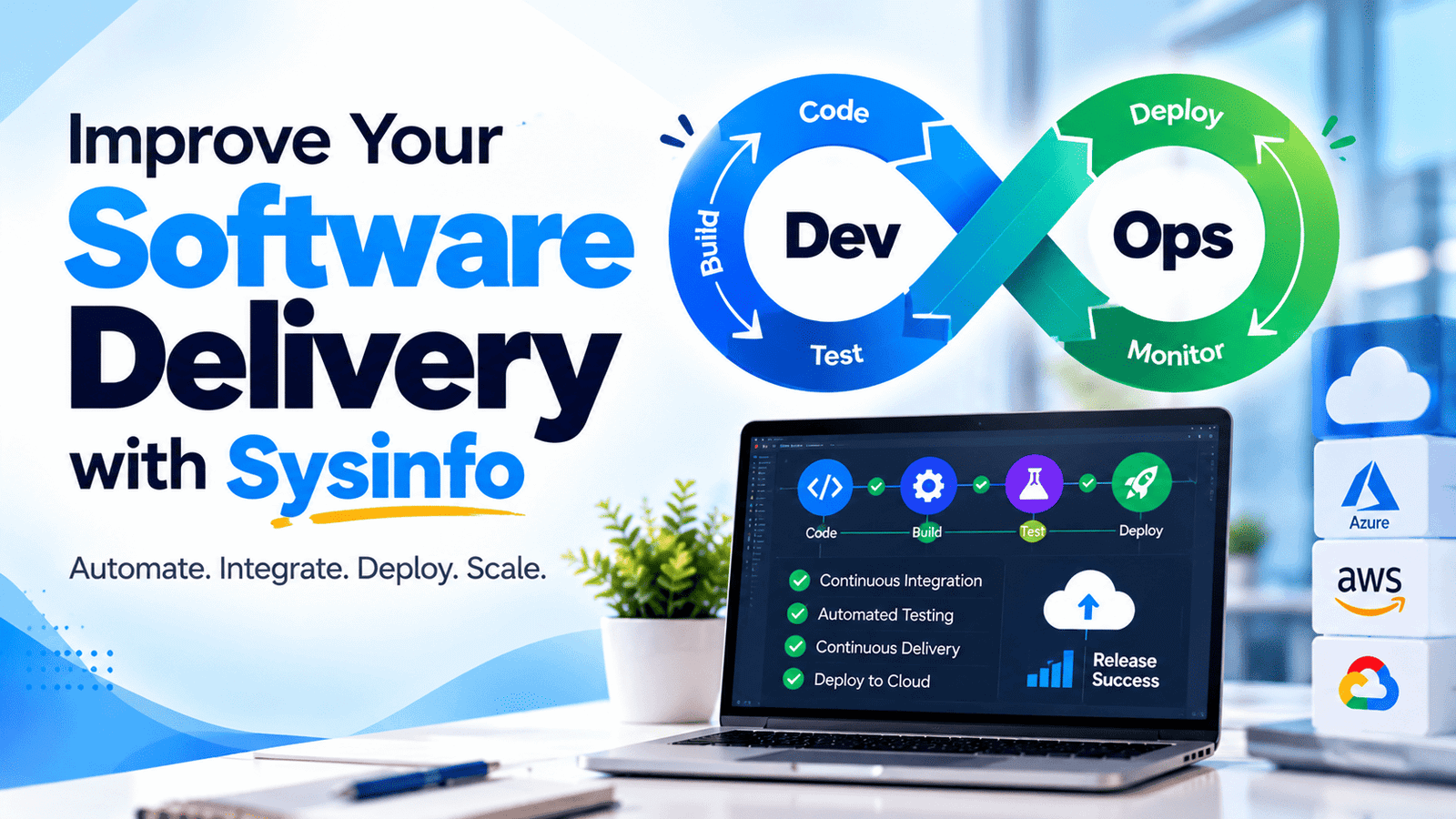
DevOps services improve collaboration between development, testing, security, and operations teams. CI/CD services automate software integration, testing, delivery, and, where appropriate, deployment to production.
Continuous Integration (CI) automatically builds and tests code changes as they are integrated into a shared codebase. Continuous Delivery (CD) extends the process by preparing tested software for release to the required environments. Continuous Deployment automatically releases qualifying changes to production when configured checks pass.
DevOps can reduce repetitive manual work, improve collaboration, identify defects earlier, standardize deployment procedures, and provide better visibility into application performance and operational issues.
Depending on your requirements, Sysinfo can work with Azure DevOps, Azure Pipelines, GitHub Actions, Jenkins, GitLab CI/CD, and related source control, testing, and deployment tools.
Infrastructure as Code is a practice for defining and managing infrastructure through version-controlled files. It helps teams provision and update environments consistently, review infrastructure changes, and reduce manual configuration work.
Yes. DevOps practices can be applied to .NET, ASP.NET Core, Java, Spring Boot, APIs, web applications, microservices, and many other technology stacks.
No. Kubernetes is useful for managing containerized applications that need orchestration, scaling, and related capabilities. Many applications can use simpler deployment approaches, and the technology choice should match the project's requirements.
Automated testing validates application changes during the delivery process. It helps identify defects earlier and provides feedback before software advances to later environments or production.
Yes. We can design deployment pipelines for supported Azure and AWS environments, including build automation, testing, environment configuration, approvals, deployment verification, and monitoring.
Yes. Ongoing support can include pipeline troubleshooting, build failures, deployment issues, infrastructure updates, monitoring improvements, tool integration, and optimization of the delivery process.
Copyright © 2026 Sysinfo Solutions