Building and managing applications traditionally involves maintaining servers, configuring infrastructure, handling capacity, and managing deployment environments. As business requirements change, these responsibilities can take time away from application development and innovation.
At Sysinfo, we provide Serverless Computing Services that help businesses develop, deploy, and operate modern applications using cloud-managed infrastructure and event-driven technologies.
Serverless computing allows development teams to focus more on application functionality while cloud providers manage much of the underlying server provisioning, infrastructure maintenance, and resource allocation. Applications can execute functions in response to events, process requests, connect with managed services, and scale according to workload requirements.
Whether you are developing a new cloud-based application, modernizing an existing system, building API-driven services, or automating business workflows, we help evaluate serverless architecture options based on your technical requirements and business objectives.
From serverless application development and Function as a Service (FaaS) to API integration, event-driven architecture, cloud database connectivity, monitoring, and ongoing optimization, our approach focuses on building solutions that are practical to maintain and ready to evolve.
Planning a serverless application or looking to modernize your cloud architecture? Let’s discuss your requirements and explore the right approach for your business.
CTA: Discuss Your Serverless Computing Requirements | Request a Consultation
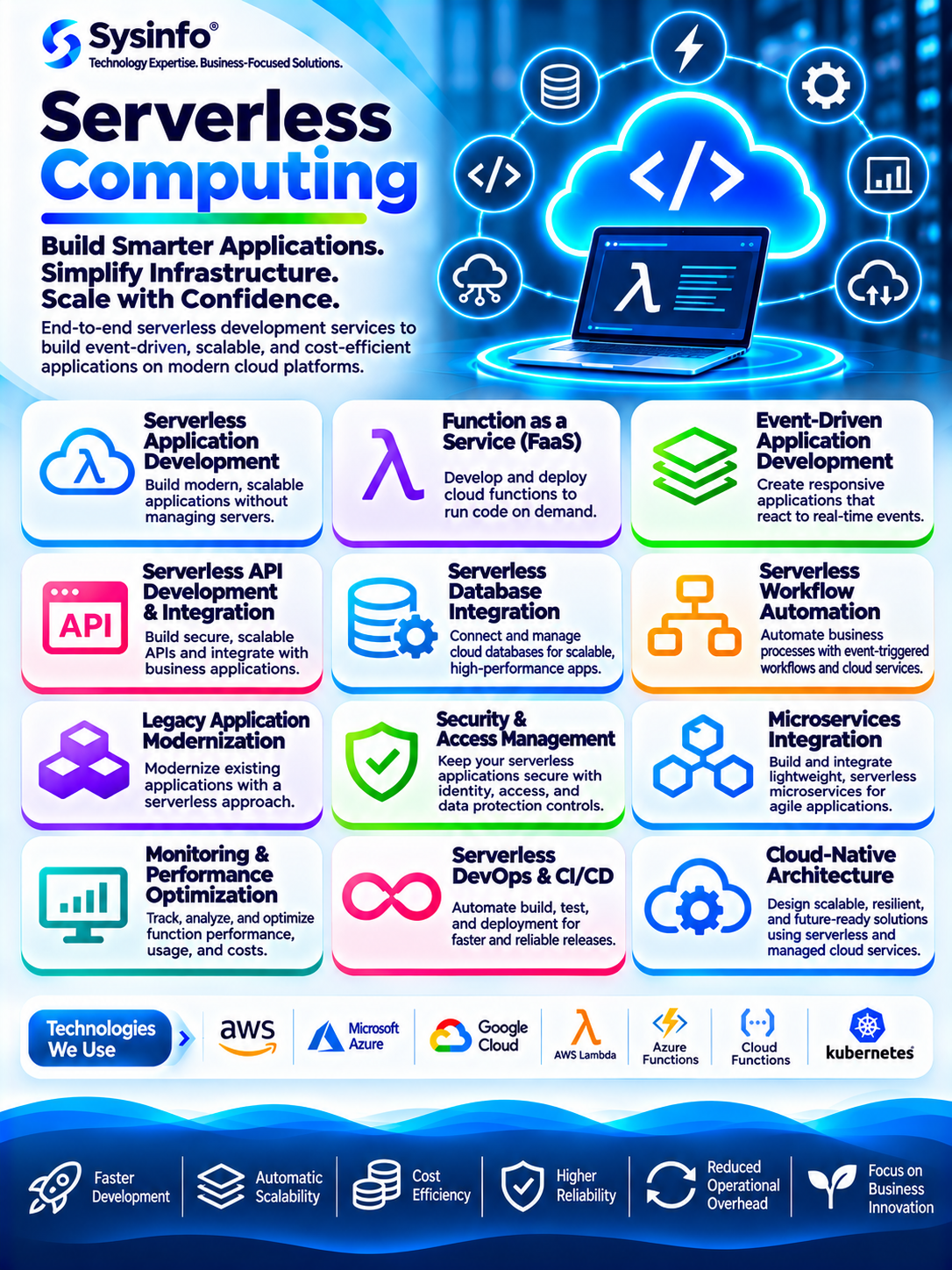
Serverless computing is a cloud computing model in which the cloud provider manages much of the underlying infrastructure required to run application code and services. Developers can focus on application functionality without having to provision and maintain traditional servers for every workload.
Despite its name, serverless computing still uses servers. The difference is that infrastructure provisioning, execution environments, and much of the operational management are handled by the cloud platform.
A common serverless approach uses Function as a Service (FaaS), where individual functions execute in response to events such as API requests, file uploads, database changes, or scheduled tasks.
Serverless applications may also use managed databases, messaging services, authentication platforms, storage, and API gateways.
Depending on your business requirements, serverless computing may involve:
Serverless application development
Function as a Service (FaaS)
Event-driven application architecture
Serverless API development
Cloud-native application integration
Managed database connectivity
Automated background processing
Serverless workflow automation
Application security and access management
Monitoring and performance optimization
Deployment automation
Ongoing serverless application support
At Sysinfo, we consider your application architecture, workload characteristics, integration requirements, and cloud environment before recommending a suitable serverless solution.
Serverless application development allows businesses to build applications using cloud-managed services and event-driven execution models without managing traditional application servers for every component.
Sysinfo supports serverless application development based on your business requirements, application functionality, and selected cloud platform.
Our serverless application development services may include:
Custom serverless application development
Cloud-native application components
Function-based application logic
Application workflow development
API-driven application architecture
Managed cloud service integration
Database connectivity
Application deployment support
Application testing and validation
Ongoing application enhancement
We focus on building applications with clearly defined components, suitable service integrations, and architecture that supports future development.
Function as a Service allows developers to run individual pieces of application code in response to specific events. Instead of maintaining a continuously running server for every task, functions execute when triggered by configured events.
This approach can be useful for applications that process requests, perform background tasks, respond to data changes, or execute scheduled operations.
Our FaaS development support may include:
Serverless function development
Event-triggered code execution
Backend business logic
Scheduled function execution
Data processing functions
Application event handling
Function integration with APIs
Error handling and logging
Function testing
Deployment and configuration support
We consider execution frequency, processing requirements, dependencies, and service limits when designing serverless functions.
Event-driven architecture allows applications to respond to events generated by users, applications, databases, messaging systems, or external services.
Instead of requiring every component to communicate through direct, continuous connections, event-driven systems can use events to trigger specific actions and workflows.
Sysinfo supports event-driven application development for business processes that benefit from asynchronous communication and automated execution.
Our event-driven development services may include:
Event-based application architecture
Event producer and consumer development
Message-driven workflows
Application event processing
Database event handling
File upload event processing
Scheduled and triggered operations
Event routing and integration
Error handling and retry mechanisms
Event monitoring and troubleshooting
We help define event flows and processing responsibilities so that application components can communicate in a structured way.
APIs allow applications, platforms, and services to exchange information. Serverless architecture can support API back ends by using cloud-managed API gateways and functions to process requests.
Sysinfo supports serverless API development and integration for applications that need flexible communication between different systems.
Our serverless API services may include:
REST API development
API gateway configuration
Serverless API back-end development
Request and response processing
Authentication and authorization integration
Third-party API connectivity
Data validation and transformation
API versioning considerations
Error handling
API testing and monitoring
We consider security, request volumes, response requirements, and application dependencies when planning serverless APIs.
Cloud-native architecture uses cloud services and modern application design practices to build systems that can evolve with changing business requirements.
Serverless computing can form part of a cloud-native architecture by using managed execution environments, event-driven services, APIs, and cloud databases.
Our cloud-native serverless support may include:
Serverless architecture planning
Application component design
Function-based services
API-driven communication
Managed cloud service integration
Event-driven workflows
Application configuration
Deployment architecture
Service dependency planning
Architecture documentation
We evaluate the application requirements and operational complexity before recommending a serverless architecture.
Serverless applications often depend on managed databases to store customer information, transactions, application records, and operational data.
Choosing an appropriate database depends on data structure, access patterns, consistency requirements, query needs, and application workloads.
Sysinfo supports serverless database integration based on your application and data requirements.
Our database integration services may include:
Managed cloud database connectivity
Relational database integration
NoSQL database integration
Data access layer development
Database query implementation
Data validation
Connection and access management
Database event integration
Data synchronization workflows
Database performance considerations
We consider database behavior, connection management, access controls, and application workload patterns when designing serverless database interactions.
Many business processes involve repetitive actions such as processing submitted forms, sending notifications, updating records, generating documents, and moving information between applications.
Serverless workflows can help automate these activities by connecting cloud functions, event triggers, messaging services, and managed workflow tools.
Our serverless workflow automation support may include:
Event-triggered business workflows
Automated notifications
Document processing workflows
Background task execution
Data processing automation
Application integration workflows
Scheduled operations
Approval workflow integration
Workflow error handling
Automated task monitoring
We first understand your existing process and identify which activities can be automated effectively using serverless services.
Older applications may depend on traditional servers, tightly connected components, and infrastructure configurations that become difficult to maintain as requirements change.
Serverless architecture can provide an option for modernizing selected application components without necessarily replacing the entire system.
Sysinfo supports serverless modernization initiatives based on existing application architecture and business requirements.
Our modernization support may include:
Legacy application assessment
Serverless migration planning
Function-based component development
API layer modernization
Background process modernization
Database and service integration
Application dependency analysis
Incremental modernization
Testing and validation
Deployment planning
We assess which components are suitable for serverless execution and which may be better retained in their existing hosting environment.
Serverless applications still require appropriate security controls. Functions, APIs, databases, storage services, and event sources need carefully managed access and configuration.
Security should be considered throughout the application lifecycle rather than added only after deployment.
Our serverless security support may include:
Identity and access management
Function-level permissions
Role-based access controls
API authentication integration
Secrets management considerations
Secure configuration practices
Data protection considerations
Dependency security reviews
Security monitoring integration
Deployment security checks
We consider the security requirements of the application, the cloud provider's shared responsibility model, and the sensitivity of the information being processed.
Microservices architecture divides an application into smaller services that can be developed and maintained independently. Serverless functions can be used to implement selected services or event-processing components within this architecture.
Sysinfo supports integration between serverless functions and microservices-based applications where the architecture and workload requirements make this approach suitable.
Our services may include:
Function-based microservices
API-driven service communication
Event-based service integration
Independent service deployment
Message queue integration
Service authentication
Data exchange between services
Error handling and retry strategies
Service monitoring
Architecture documentation
We consider service boundaries, communication patterns, data consistency, and operational complexity when planning these integrations.
Serverless applications require visibility into function execution, request processing, errors, latency, resource usage, and service dependencies.
Monitoring helps technical teams understand how applications behave and identify issues that may affect performance or reliability.
Our serverless monitoring and optimization support may include:
Function execution monitoring
Application log analysis
Error and exception tracking
Request latency analysis
Execution duration reviews
Resource utilization assessment
Alert configuration
Service dependency monitoring
Performance troubleshooting
Function configuration optimization
We help define monitoring practices based on application behavior, expected usage, and operational requirements.
Serverless applications still need structured development, testing, version control, and deployment processes.
DevOps practices help teams manage application changes consistently and automate selected stages of the release lifecycle.
Our serverless DevOps support may include:
Serverless application deployment workflows
CI/CD pipeline integration
Automated build processes
Infrastructure as Code
Environment configuration
Function version management
Automated testing integration
Release validation
Deployment rollback planning
Deployment documentation
We align deployment processes with the application's architecture, cloud platform, and release requirements.
A successful serverless project starts with understanding the application requirements and deciding whether serverless architecture is the right fit.
At Sysinfo, the implementation approach can be organized into the following stages.
We discuss your business objectives, application features, user requirements, existing systems, expected workloads, and technical constraints.
We evaluate the application components, data flows, integration requirements, event sources, and opportunities for serverless implementation.
We identify suitable cloud services, function execution environments, database options, API technologies, and development tools according to the project requirements.
We define application components, function responsibilities, event triggers, communication patterns, security controls, and deployment requirements.
We develop the required functions, APIs, workflows, database connections, and application integrations according to the agreed scope.
We validate function execution, API behavior, event processing, error handling, security configurations, and relevant performance requirements.
We prepare the serverless application for deployment using the agreed cloud environment and release process.
After deployment, we can support monitoring, troubleshooting, configuration improvements, function updates, and application enhancements.
The exact process and deliverables depend on application complexity, cloud platform, integration requirements, and selected engagement model.
Choosing a serverless development partner requires more than familiarity with cloud platforms. You need an approach that considers application functionality, infrastructure responsibilities, data requirements, security, and long-term maintainability.
At Sysinfo, we focus on practical technology solutions that connect serverless architecture with your business objectives.
We begin by understanding what your application needs to accomplish and evaluate whether serverless computing is suitable for its workloads and operational requirements.
Different cloud platforms offer different serverless services. We consider your existing technology environment, application architecture, and integration needs when evaluating suitable options.
Clear function responsibilities, organized application components, documentation, and testing help make serverless applications easier to understand and maintain.
We consider how serverless functions and cloud services will connect with your databases, APIs, business applications, and existing infrastructure.
Access permissions, secure configuration, testing, logging, and monitoring are important parts of serverless application development.
We consider version control, automated testing, deployment workflows, and environment configuration to support consistent application releases.
Serverless applications continue to evolve after launch. We can discuss maintenance, troubleshooting, monitoring, and enhancement activities according to your support requirements.

Serverless computing can provide practical advantages for applications with suitable workload patterns and architectural requirements.
Potential benefits include:
Cloud providers manage much of the underlying server provisioning and infrastructure maintenance, allowing development teams to focus more on application functionality.
Serverless platforms can automatically adjust execution capacity according to supported workload patterns and service limits.
Applications can respond to events such as API requests, file uploads, scheduled tasks, and data changes without requiring every component to run continuously.
Function-based development can help teams build and deploy individual application components without managing a traditional server environment for each one.
Serverless applications can connect with managed databases, storage, messaging, authentication, and other cloud services.
Many serverless platforms charge according to execution, requests, resource consumption, or service usage. This can be cost-effective for certain workloads, although costs depend on execution patterns and related managed services.
Serverless functions can support event-driven applications, APIs, background processing, and selected microservices components.
Businesses can modernize selected application components incrementally rather than replacing an entire system at once.
Serverless computing is not automatically the best choice for every application. Workload duration, execution limits, latency requirements, data access patterns, vendor dependencies, and cost behavior should be evaluated before implementation.
The appropriate serverless technology stack depends on your cloud environment, application requirements, programming languages, integration needs, and operational priorities.
Depending on the project, serverless computing solutions may involve:
AWS Serverless: AWS Lambda, Amazon API Gateway, Amazon EventBridge, Amazon SQS, and other suitable AWS services.
Microsoft Azure Serverless: Azure Functions, Azure Logic Apps, Azure API Management, and other supported Azure services.
Google Cloud Serverless: Google Cloud Run, Cloud Functions, Eventarc, and other suitable Google Cloud services.
Application Development: .NET, ASP.NET Core, Java, Spring Boot, Python, JavaScript, and other supported programming technologies.
API Technologies: REST APIs, API gateways, authentication services, and application integration tools.
Databases: Managed relational and NoSQL database services.
Messaging and Events: Message queues, event buses, notifications, and event-driven integration services.
DevOps and Deployment: Git, CI/CD pipelines, Infrastructure as Code, and automated deployment workflows.
Monitoring and Logging: Cloud-native monitoring, centralized logs, application tracing, and alerting services.
Not every project requires all these technologies. We recommend selecting tools according to your application architecture, expected workload, cloud platform, and long-term maintenance needs.
Your applications should be designed around business functionality, user needs, and future requirements—not unnecessary infrastructure complexity.
Whether you are planning a new serverless application, developing cloud functions, modernizing an existing system, building event-driven workflows, or integrating cloud services, Sysinfo can discuss your requirements and explore a suitable technical approach.
Tell us about your application idea, current infrastructure, or cloud modernization goals. Let’s explore how Serverless Computing can support your business.
Serverless computing can support different industries by helping organizations develop event-driven applications, automate selected processes, and connect cloud-based services.
Our solutions may support:
Transaction-related processing, notification workflows, API back ends, and selected data-processing applications, subject to security and regulatory requirements.
Event-based operational processing, system integrations, data notifications, and selected automation workflows.
Appointment-related workflows, notifications, document processing, and application integrations, subject to applicable privacy and data protection requirements.
Cloud-native application components, API back ends, event processing, background jobs, and application modernization.
Order processing, product update events, customer notifications, inventory workflows, and API-based commerce integrations.
Document workflows, business notifications, customer-facing APIs, automated task processing, and application integrations.
Student registration workflows, learning application integrations, notifications, and scheduled data-processing activities.
The appropriate serverless solution depends on application requirements, data sensitivity, integration needs, and the operational environment.
Serverless computing is a cloud computing model in which the cloud provider manages much of the underlying infrastructure required to execute application code and services. Developers can focus on application functionality without managing traditional servers for every workload.
No. Servers are still used to run applications. The term serverless refers to the cloud provider managing the underlying infrastructure and execution environment rather than the customer directly provisioning and maintaining traditional servers for each workload.
Function as a Service is a cloud computing model that allows developers to execute individual functions in response to events. Examples include processing API requests, responding to file uploads, updating records, and executing scheduled tasks.
Traditional cloud hosting often involves managing virtual machines, server configurations, operating systems, and application environments. Serverless computing uses managed execution services where the cloud provider handles much of the underlying infrastructure management.
Major cloud platforms offer serverless services, including AWS Lambda on Amazon Web Services, Azure Functions on Microsoft Azure, and Google Cloud's serverless offerings. The right platform depends on application requirements and the existing technology environment.
Yes. Serverless services can support selected enterprise application components, APIs, integrations, event processing, and automation workflows. Enterprise suitability depends on architecture, security, compliance, workload requirements, and integration complexity.
No. Serverless computing is suitable for many event-driven and variable workloads, but it may not be ideal for applications requiring continuous processing, specialized infrastructure control, predictable low latency, or execution beyond platform limits. Architecture assessment helps determine suitability.
Serverless platforms can automatically adjust execution capacity according to incoming requests or events, within the platform's configuration and service limits. Application design, concurrency settings, quotas, and downstream dependencies also influence scaling behavior.
It can be cost-effective for workloads with variable or intermittent usage because many platforms charge based on execution or consumption. However, costs depend on invocation volume, execution duration, memory or resource allocation, data transfer, and related managed services.
Serverless computing can support secure application architectures when appropriate controls are implemented. Identity management, permissions, secure API access, secrets management, dependency reviews, and monitoring should all be considered.
Yes, selected application components can often be modernized or migrated to serverless services. The process may involve identifying suitable functions, separating application responsibilities, developing APIs, and integrating managed cloud services. Not every component needs to be migrated.
Event-driven architecture allows applications to perform actions when specific events occur. Events may come from API requests, database changes, file uploads, message queues, or scheduled tasks. Serverless functions can process these events and trigger additional workflows.
Yes. Serverless applications can connect to managed databases, internal systems, and third-party services through supported APIs and integration methods. Connection management, authentication, permissions, and service limits should be considered during design.
Serverless applications still benefit from DevOps practices such as version control, automated testing, CI/CD pipelines, deployment automation, infrastructure configuration, monitoring, and release management.
The timeline depends on application complexity, required features, integrations, data architecture, cloud platform, security requirements, and testing scope. A requirement assessment helps establish a realistic development plan.
Costs depend on development scope, cloud platform, function execution patterns, API requests, data storage, database usage, integrations, monitoring, and ongoing support. A technical assessment helps identify the expected service requirements and cost considerations.
Share your application idea, current infrastructure, expected workloads, preferred cloud platform, integration requirements, and business objectives. Sysinfo can then discuss the technical scope and possible implementation approach.
Copyright © 2026 Sysinfo Solutions