Businesses generate information every day through customer interactions, sales activities, applications, transactions, operations, and internal systems. However, collecting data is only the beginning. The real value comes from understanding that information, identifying useful patterns, and applying those insights to everyday business decisions.
At Sysinfo, we provide Data Analytics & Automation Services that help organizations make better use of their business information, improve reporting, simplify repetitive processes, and build more informed workflows.
From data collection and integration to business intelligence dashboards, reporting solutions, workflow automation, and data-driven decision support, we help connect information with practical business objectives.
Whether you want to bring data from multiple systems into one reporting environment, automate manual business activities, improve management reporting, or build a stronger foundation for data-driven decision-making, our approach begins with understanding your business processes and information requirements.
We focus on creating practical solutions that make data easier to access, reports easier to understand, and business workflows easier to manage.
Looking to make better use of your business data or reduce repetitive manual work? Let’s discuss your requirements and explore the right approach for your organization.
CTA: Discuss Your Data & Automation Requirements | Request a Consultation
Data analytics and automation services help businesses organize information, understand business performance, and simplify repetitive tasks through technology.
Data analytics involves collecting, preparing, analyzing, and interpreting information to identify trends, patterns, performance indicators, and opportunities for improvement.
Business process automation uses software, workflows, integrations, and automation tools to perform selected repetitive activities with less manual intervention.
When combined, data analytics and automation can help organizations move from manually collecting information and preparing reports toward more connected, efficient, and insight-driven operations.
Depending on your business requirements, these services may involve:
Data collection and integration
Data cleaning and preparation
Business intelligence and reporting
Interactive dashboards and KPI tracking
Data visualization and performance analysis
Data warehouse and analytics solutions
Workflow and process automation
Application and system integration
Automated reporting and notifications
Data quality and governance
Predictive analytics and forecasting support
At Sysinfo, we consider your existing applications, data sources, reporting requirements, and business processes before recommending an appropriate solution.
Business information becomes more valuable when it can be understood and used effectively. Data analytics and business intelligence solutions help organizations examine information from different sources and identify insights that support planning and decision-making.
Sysinfo supports the development and implementation of data analytics solutions based on your business requirements.
Our data analytics and business intelligence services may include:
Business data analysis
Data source identification and integration
Business performance reporting
KPI definition and tracking
Trend and pattern analysis
Interactive reporting solutions
Data visualization
Management dashboards
Operational performance analysis
Decision-support reporting
We focus on presenting information in a meaningful format so business users can understand performance, identify areas that need attention, and make more informed decisions.
Many organizations store business information across different applications, databases, spreadsheets, and platforms. Working with disconnected data can make reporting difficult and create inconsistent information across departments.
Data integration helps bring relevant information together from multiple sources for analysis and reporting.
Our data integration services may include:
Data integration planning
Database and application connectivity
Data extraction and consolidation
API-based data integration
Structured data transformation
Data synchronization
Multi-source reporting integration
Data validation
Data migration support
Integration monitoring and maintenance
We evaluate the structure, quality, and availability of your existing data before planning an integration approach.
Business users should not have to examine large spreadsheets or disconnected reports to understand what is happening in their organization.
Interactive dashboards present important information through visual elements such as charts, graphs, tables, indicators, and filters.
Sysinfo supports dashboard and data visualization solutions designed around business reporting needs.
Our dashboard development services may include:
Executive management dashboards
Sales performance dashboards
Financial reporting dashboards
Customer analytics dashboards
Operational performance dashboards
Department-specific reporting
KPI visualization
Interactive charts and graphs
Data filtering and drill-down views
Scheduled dashboard updates
We organize dashboard information according to the needs of different users, helping managers and teams access relevant performance information more easily.
When business information grows across multiple systems, organizations may need a structured environment for storing and preparing data for reporting and analysis.
A data warehouse can bring together information from different sources in an organized format to support consistent reporting and analytical activities.
Our data warehousing and data management support may include:
Data warehouse planning
Data modeling and structuring
Data source integration
Data transformation
Data loading workflows
Historical data organization
Data quality checks
Data storage architecture
Reporting data preparation
Warehouse maintenance support
We consider the volume, structure, frequency, and intended use of your data when planning a suitable data management approach.
Data from different systems may contain missing values, duplicate records, inconsistent formats, outdated information, or other quality issues.
Data cleaning and preparation help make information more consistent and suitable for reporting and analysis.
Our data preparation services may include:
Duplicate record identification
Data format standardization
Missing value assessment
Data validation
Data transformation
Data normalization
Data quality checks
Data mapping
Record matching
Preparation for reporting and analytics
We help establish appropriate data preparation processes so reports and analytical outputs are based on more consistent information.
Many business processes involve repeated activities such as transferring information between systems, preparing documents, updating records, sending notifications, and generating reports.
Business process automation helps simplify selected tasks by defining workflows that can be executed automatically when specific conditions are met.
Sysinfo supports business process automation based on your operational requirements.
Our business process automation services may include:
Repetitive task automation
Approval workflow automation
Document processing workflows
Data entry and record updates
Notification and alert automation
Task assignment workflows
Business rule implementation
Application-based automation
Workflow integration
Process monitoring
We first understand how your existing processes work and then identify which activities are suitable for automation.
Some organizations depend on repetitive, rule-based activities performed through multiple applications. Robotic Process Automation (RPA) can help automate selected tasks by using software bots to interact with systems and perform defined actions.
Our RPA-related automation support may include:
Repetitive data entry automation
Application-based task automation
Data extraction and transfer
Report preparation workflows
Form processing
Record validation
Scheduled task execution
Cross-application workflow automation
Exception handling
Automation monitoring
RPA is most appropriate for processes with clearly defined rules and repeatable steps. We assess process suitability before recommending automation.
Preparing reports manually can take time, especially when information must be collected from several sources and formatted repeatedly.
Automated reporting can help organizations generate and distribute reports according to predefined schedules, business rules, and reporting requirements.
Our automated reporting services may include:
Scheduled report generation
Automated data collection
Report formatting and consolidation
Department-wise reporting
KPI report automation
Email-based report distribution
Management reporting workflows
Exception and threshold alerts
Report validation
Reporting process maintenance
We help design reporting workflows that reduce repetitive preparation activities and make relevant information easier to access.
Historical business information can help organizations identify patterns and explore possible future outcomes. Predictive analytics uses statistical methods and, where appropriate, machine learning techniques to estimate likely trends based on available data.
Sysinfo can support predictive analytics initiatives according to the quality, availability, and suitability of your business data.
Our predictive analytics support may include:
Historical data analysis
Trend identification
Demand forecasting
Sales forecasting
Customer behavior analysis
Business performance prediction
Risk indicator analysis
Forecasting model integration
Analytical reporting
Model evaluation support
Predictions are estimates rather than guarantees. Their usefulness depends on data quality, model selection, assumptions, and changing business conditions.
Artificial intelligence can support selected analytics and automation activities by helping process information, identify patterns, generate summaries, and assist with repetitive knowledge-based tasks.
Sysinfo supports AI-related analytics and automation initiatives where they provide a practical benefit to the business process.
Possible applications may include:
AI-assisted data analysis
Automated data summarization
Intelligent document processing
Natural language-based reporting
AI-assisted business insights
Anomaly identification support
Intelligent workflow routing
Data classification
Automated information extraction
AI integration with business applications
AI-generated results should be reviewed where accuracy, privacy, security, or important business decisions are involved. We consider the intended use, data requirements, and appropriate human oversight when planning these solutions.
Business processes often involve multiple applications that need to exchange information. Connecting these systems can help reduce repeated data entry and support smoother workflows.
Sysinfo supports application and system integration to help connect business platforms and automate information exchange.
Our integration services may include:
API development and integration
CRM and ERP connectivity
Database integration
Third-party application integration
Data synchronization
Event-based workflow integration
Application-to-application communication
Automated record updates
Integration testing
Integration maintenance
The integration approach depends on the systems involved, available interfaces, data structures, access permissions, and business requirements.
Reliable analytics depends on more than dashboards and reporting tools. Organizations also need appropriate practices for managing data quality, access, consistency, and accountability.
Our data governance and quality support may include:
Data quality assessment
Data validation rules
Data ownership planning
Data access controls
Reporting definitions
KPI standardization
Data documentation
Data consistency checks
Data lifecycle considerations
Governance process recommendations
We help businesses consider how information is collected, maintained, accessed, and used across their reporting and analytics environments.
A successful analytics or automation project begins with understanding how your business currently works and what you want to improve.
At Sysinfo, the implementation approach can be organized into the following stages.
Step 1: Business Requirement Discovery
We discuss your business objectives, reporting challenges, data sources, existing applications, manual processes, and expected outcomes.
Step 2: Data and Process Assessment
We examine the available information, its structure and quality, and the workflows that may benefit from analytics or automation.
Step 3: Solution Planning and Architecture
We define the solution scope, data flow, integration requirements, reporting structure, automation logic, and suitable technology options.
Step 4: Data Integration and Preparation
We connect the required data sources, organize information, and apply appropriate transformation and validation steps.
Step 5: Analytics and Automation Development
We develop the required dashboards, reports, data workflows, automation rules, and application integrations according to the agreed scope.
Step 6: Testing and Validation
We validate data accuracy, report calculations, workflow behavior, system connectivity, access permissions, and relevant exception scenarios.
Step 7: Deployment and User Enablement
We prepare the solution for use and support the agreed deployment, documentation, and user handover activities.
Step 8: Monitoring and Continuous Improvement
After implementation, we can support reporting updates, workflow improvements, data quality reviews, troubleshooting, and additional automation opportunities.
Choosing a technology partner for analytics and automation is about more than creating reports or setting up automated tasks. You need a solution that understands your business information, processes, and decision-making requirements.
Sysinfo focuses on practical solutions that connect data, technology, and business operations.
Business-Focused Analytics
We begin by understanding what information your organization needs and how that information supports business decisions.
Connected Data and Applications
Our approach considers data sources, databases, applications, and integration requirements to help create a more connected reporting environment.
Practical Automation Opportunities
Not every manual activity needs automation. We focus on identifying repeatable processes where automation can provide a useful operational benefit.
Flexible Technology Approach
Different analytics and automation requirements call for different tools. We consider your existing environment, data architecture, and technical needs when evaluating technology options.
Focus on Data Quality
Reliable reporting requires appropriate data preparation, validation, and consistency. We consider these activities throughout the analytics lifecycle.
Clear Communication and Collaboration
Requirement discussions, documented workflows, progress reviews, and user feedback help keep business and technical stakeholders aligned.
Support Beyond Implementation
Reporting requirements and business processes change over time. We can discuss ongoing support for dashboards, integrations, data workflows, and automation improvements according to your needs.

Combining data analytics with process automation can help businesses improve how they understand information and manage everyday activities.
Potential benefits include:
Organized reporting and meaningful dashboards can help decision-makers understand business performance and evaluate available information.
Automating suitable tasks can reduce repeated data entry, report preparation, and routine administrative activities.
Connecting information from different sources can help teams access a more consistent view of relevant business activities.
Standardized data definitions, reporting structures, and automated workflows can help reduce inconsistencies between reports.
Well-designed automation can simplify selected workflows and help teams spend less time on repetitive activities.
Dashboards and scheduled reports can make relevant information available to authorized users without relying entirely on manual report preparation.
Workflow tracking, alerts, and reporting can help organizations identify delays, exceptions, and activities that require attention.
A flexible data and automation foundation can help organizations add new data sources, reporting requirements, and workflows as their operations evolve.
Actual improvements depend on data quality, process suitability, implementation scope, user adoption, and ongoing management.
The right technology stack depends on your data sources, reporting needs, application environment, automation requirements, and existing IT investments.
Depending on the project, data analytics and automation solutions may involve:
Not every project requires all these technologies. We recommend selecting tools according to the business problem, technical environment, data requirements, and long-term maintenance considerations.
Your business already has valuable information across its applications, databases, reports, and daily operations. The opportunity is to bring that information together, understand what it means, and use it to improve the way your organization works.
Whether you want to develop interactive dashboards, consolidate business data, automate repetitive processes, improve reporting, or explore predictive analytics, Sysinfo can discuss your requirements and help identify a suitable technical approach.
Tell us about your data challenges, reporting needs, or business processes you want to improve. Let’s explore the right Data Analytics & Automation solution for your organization.
Data analytics and automation can support organizations across different industries by helping them understand performance, manage information, and simplify operational workflows.
Our services may support:
Financial reporting, transaction analysis, operational dashboards, reconciliation workflows, and automated reporting, subject to relevant security and regulatory requirements.
Student information reporting, enrollment analytics, course performance dashboards, administrative reporting, and workflow automation.
Operational reporting, administrative workflow automation, appointment-related data analysis, and information management, subject to applicable privacy and compliance requirements.
Application usage analytics, project reporting, customer insights, operational dashboards, and automated internal workflows.
Sales analytics, inventory reporting, customer insights, order processing workflows, and business performance dashboards.
Client reporting, employee workflow management, document processing, service performance analysis, and business process automation.
Production reporting, operational performance analysis, inventory information, process monitoring, and workflow automation.
The specific solution and data handling requirements are evaluated according to each organization’s business processes and applicable industry standards.
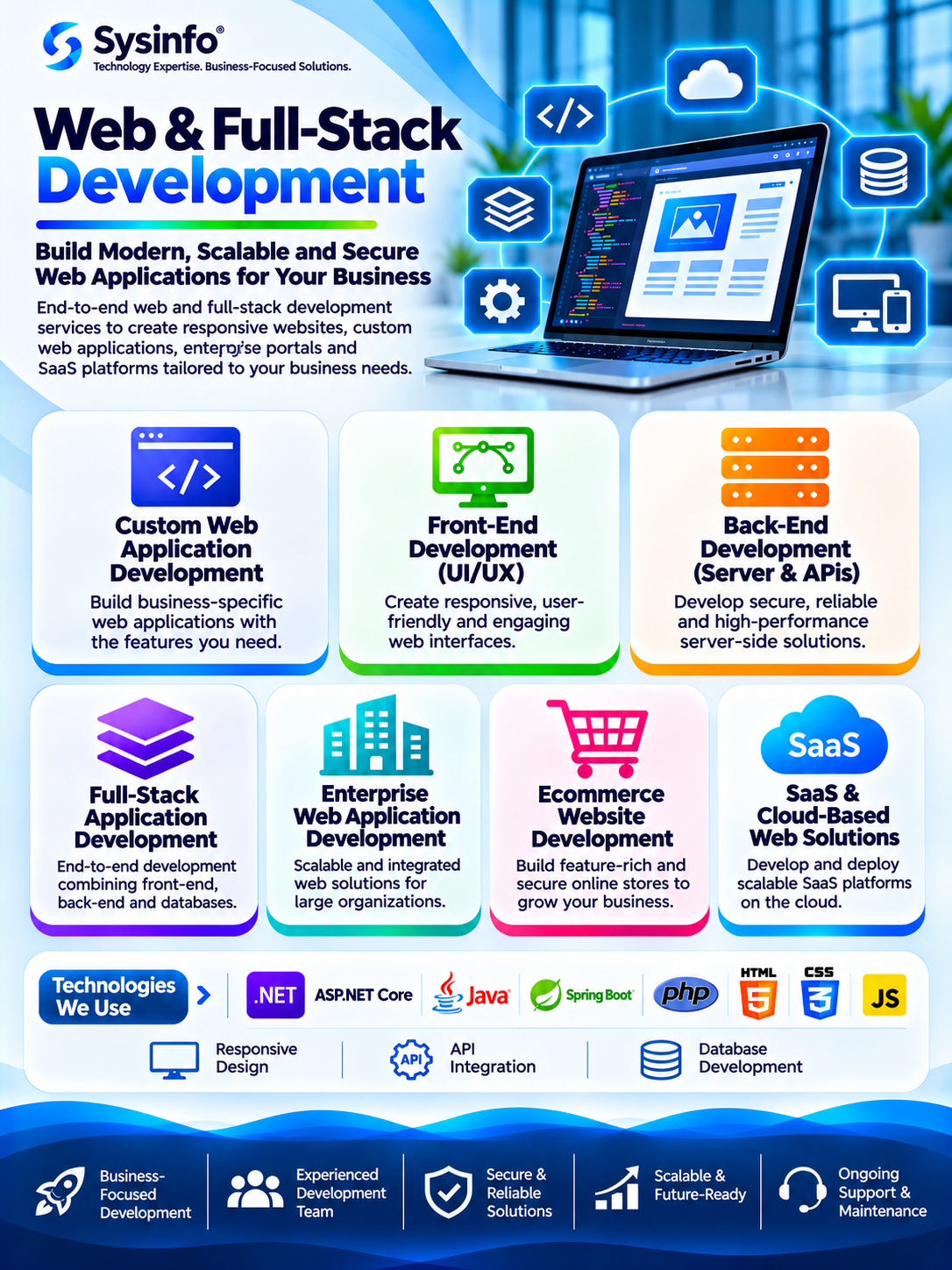
Web development involves creating websites and web-based applications. Full-stack development covers both front-end and back-end components, including user interfaces, server-side programming, databases, and application integrations.
Front-end development focuses on the parts of an application that users see and interact with. Back-end development handles server-side functionality, business logic, data processing, authentication, and database operations. Both work together to deliver a complete application.
A full-stack developer works across the different layers of a web application. This may include building user interfaces, developing server-side functionality, connecting databases, creating APIs, and troubleshooting application components.
Sysinfo provides web application and custom software development services. The application scope can be planned around your business workflows, required features, users, integrations, and preferred technology environment.
Responsive development considers different screen sizes and devices. The interface is planned so that users can access and interact with the website or application across supported desktop, tablet, and mobile browsers.
Technology selection depends on the application. Common project requirements may involve .NET, ASP.NET Core, Java, Spring Boot, PHP, JavaScript, HTML, CSS, APIs, and database technologies.
Web applications can be connected with CRM, ERP, and other business platforms through suitable APIs, connectors, or integration methods. The available approach depends on the systems involved and their technical capabilities.
Yes. Modernization may include interface improvements, framework migration, back-end updates, database changes, API integration, performance improvements, and compatibility enhancements. An initial technical assessment helps establish the appropriate scope.
Testing can be included throughout the development lifecycle. Depending on the project, it may cover functional, integration, API, responsive, compatibility, performance, and regression testing.
Sysinfo offers application maintenance and related support services. The scope may include bug fixing, updates, troubleshooting, feature improvements, and technical assistance based on agreed requirements.
The development timeline depends on the application's complexity, number of features, design requirements, integrations, technology choices, testing scope, and project resources. A requirement assessment helps establish a realistic delivery plan.
The cost depends on the project scope, application architecture, required technologies, integrations, development effort, and ongoing support requirements. A clear requirements discussion helps establish an appropriate estimate.
Start by sharing your business objectives, application idea, required features, existing system details, preferred timeline, and technical expectations. The next step is to discuss the project scope and suitable development approach.
Copyright © 2026 Sysinfo Solutions