Moving business applications and infrastructure to the cloud is an important step, but managing that environment effectively is just as important. Cloud resources need regular monitoring, security reviews, performance management, maintenance, and cost control to support changing business requirements.
At Sysinfo, we provide Cloud Management and Support Services that help businesses maintain, monitor, and improve their cloud environments. Our approach focuses on keeping cloud infrastructure organized, supporting application availability, managing resources, and addressing technical challenges as they arise.
Whether your organization operates on a public cloud platform, uses a hybrid infrastructure, or manages multiple cloud environments, we help you plan and manage the operational activities required to keep your systems running effectively.
From cloud infrastructure administration and performance monitoring to security management, backup planning, troubleshooting, and resource optimization, our services are aligned with your technical environment and business priorities.
We understand that every organization has different cloud requirements. That is why we focus on practical management and support approaches based on your existing infrastructure, applications, workloads, and operational expectations.
Looking for reliable support to manage your cloud infrastructure? Let’s discuss your environment and identify how Sysinfo can support your cloud operations.
CTA: Discuss Your Cloud Management Requirements | Request a Consultation
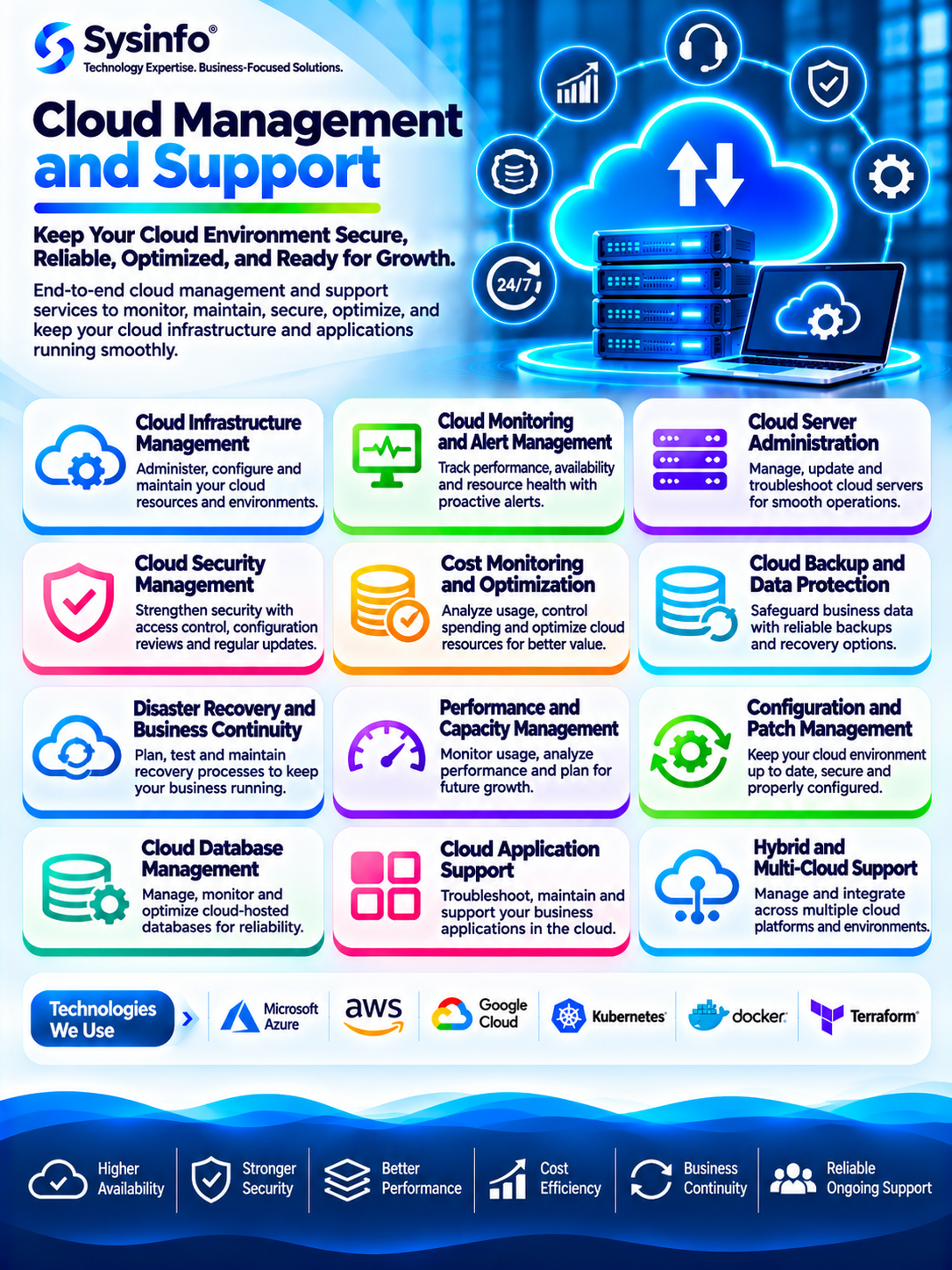
Cloud management and support services involve the ongoing administration, monitoring, maintenance, and optimization of cloud-based infrastructure, applications, and resources.
Businesses use cloud environments to host applications, store information, manage databases, operate development platforms, and support day-to-day business activities. These environments require regular attention to maintain performance, security, availability, and operational consistency.
Cloud management brings these activities together through structured processes, monitoring tools, automation, and technical support.
Depending on your business requirements, cloud management and support may include:
At Sysinfo, we consider your cloud platform, application dependencies, infrastructure design, and support expectations before recommending a suitable management approach.
Cloud infrastructure includes the computing, storage, networking, and other resources that support your applications and business systems. Managing these components properly helps maintain a structured and dependable cloud environment.
Sysinfo supports cloud infrastructure management based on your operational requirements and existing architecture.
Our cloud infrastructure management services may include:
We help businesses maintain visibility into their cloud infrastructure and manage resources according to application and workload requirements.
Cloud environments need continuous visibility into resource usage, application performance, availability, and operational events. Monitoring helps technical teams identify unusual activity and investigate issues before they become larger problems.
Our cloud monitoring support may include:
We help define monitoring requirements around the systems being managed, the importance of each workload, and the expected support responsibilities.
Monitoring frequency and incident response coverage should be agreed according to your required support model.
Cloud-based servers need regular administration to maintain their configuration, operating environment, and application dependencies.
Sysinfo provides cloud server administration support based on the server platforms and operating environments involved.
Our server management services may include:
We consider the server's purpose, application dependencies, and operational requirements when planning maintenance and support activities.
Cloud security requires attention to access permissions, infrastructure configurations, application environments, network controls, and data protection practices.
Although cloud providers secure their underlying platforms, organizations must also manage the security of their own resources, identities, applications, and configurations.
Sysinfo supports cloud security management activities that may include:
Our approach considers the security responsibilities of both the cloud provider and your organization, along with the requirements of your applications and business operations.
Cloud resources are often billed according to usage, capacity, service selection, and consumption patterns. Without regular reviews, unused resources or unsuitable configurations can contribute to unnecessary expenditure.
Cloud cost management helps businesses understand where their cloud budget is being used and identify opportunities to improve resource utilization.
Our cloud cost optimization support may include:
We focus on understanding actual workloads and usage requirements before recommending changes. Cost optimization should maintain an appropriate balance between expenditure, performance, availability, and business needs.
Business information is one of an organization's most important resources. Data loss, accidental deletion, system failures, and operational disruptions can affect business continuity.
Cloud backup solutions help protect important data and support recovery when information or systems become unavailable.
Sysinfo can support cloud backup planning and management based on your data protection requirements.
Our backup services may include:
We help businesses consider which information needs protection, how frequently backups should be taken, and how restoration should be handled.
A backup is only useful when it can be restored successfully, so recovery validation should form part of the backup management process.
Unexpected events such as infrastructure failures, application outages, cyber incidents, or regional service disruptions can affect access to business systems.
Disaster recovery planning helps organizations prepare for these situations by defining how important systems and information can be restored.Our disaster recovery support may include:An application may experience performance problems when cloud resources are not configured according to workload requirements. Changes in user activity, data volume, and application demand can also affect performance.
Cloud performance and capacity management help organizations understand resource behavior and plan appropriate infrastructure adjustments.
Our support may include:
Infrastructure performance monitoring
Server resource analysis
Application performance reviews
CPU and memory utilization assessment
Storage performance reviews
Network performance analysis
Capacity planning
Resource scaling recommendations
Performance issue investigation
Configuration improvement recommendations
We consider workload patterns and application requirements before recommending infrastructure changes.
Cloud infrastructure and applications require regular updates to address compatibility, maintenance, and security requirements.
Configuration management helps maintain consistency across cloud environments, while patch management supports the planned application of relevant software and operating system updates.
Our services may include:
We consider application compatibility, operational impact, and maintenance windows when planning updates.
Cloud-hosted databases support applications that depend on customer records, transactions, business information, and operational data.
Database environments need appropriate monitoring, maintenance, access management, backup planning, and performance reviews.
Sysinfo supports cloud database management activities based on the database technologies and service environments involved.
Our database support may include:
We consider application dependencies, data requirements, and operational expectations when supporting cloud database environments.
Cloud-hosted applications depend on multiple components, including servers, databases, APIs, networks, and external integrations. When one component experiences an issue, it can affect the overall application experience.
Sysinfo supports cloud application troubleshooting and maintenance to help businesses investigate technical issues and maintain their application environments.
Our application support services may include:
We work to identify the underlying issue and determine appropriate corrective actions based on the application's architecture and support scope.
As cloud environments grow, businesses need consistent practices for managing access, configurations, resource ownership, and operational responsibilities.
Cloud governance helps establish policies and controls that guide how cloud resources are created, accessed, maintained, and monitored.
Our cloud governance support may include:
Compliance requirements vary by industry, geography, and application. We help identify relevant operational considerations, while formal compliance certification or legal assurance requires the appropriate independent assessment.
Some organizations use a combination of on-premises infrastructure and cloud platforms. Others distribute workloads across multiple cloud providers to meet technical or business requirements.
Managing these environments requires visibility into different infrastructure components, connectivity, access arrangements, and operational responsibilities.
Sysinfo can support hybrid and multi-cloud management activities based on your existing architecture.
Our support may include:
We consider the complexity of each environment before recommending a management approach that supports consistent operations.
Cloud environments are not static. New applications, infrastructure changes, software updates, and business requirements create an ongoing need for technical attention.
Sysinfo can discuss ongoing cloud support and maintenance arrangements according to your operational needs.
Our support may include:
Support hours, service coverage, response targets, escalation procedures, and responsibilities should be clearly defined in the agreed service arrangement.
Effective cloud management requires a structured approach to understanding your infrastructure, identifying operational needs, and maintaining consistent support activities.
At Sysinfo, the management approach can be organized into the following stages.We begin by understanding your existing cloud platforms, applications, infrastructure components, databases, network configuration, and operational requirements.
We identify the areas where management or technical support is required, including monitoring, security, maintenance, backup, performance, and cost management.
We review the cloud environment and document relevant infrastructure components, access arrangements, dependencies, and operational responsibilities.
We establish or review monitoring, alerting, resource visibility, and routine management processes according to the agreed support scope.
We review relevant access controls, configuration requirements, patching needs, backup arrangements, and other operational considerations.
When issues arise, we follow the agreed support and escalation process to investigate problems, identify possible causes, and coordinate corrective actions.
We review resource utilization, application performance, and cloud usage to identify suitable optimization opportunities.
We review operational findings, update documentation, and recommend improvements as your cloud environment and business requirements evolve.
The exact process, monitoring frequency, and service responsibilities depend on the infrastructure, support model, and agreed service-level expectations.
Managing a cloud environment requires a combination of infrastructure knowledge, operational discipline, security awareness, and ongoing technical support.
At Sysinfo, we focus on understanding your cloud environment and providing practical management approaches that support your business operations.
We consider the applications and business processes that depend on your infrastructure before planning management and support activities.
We focus on organized resource management, documentation, monitoring, and maintenance practices to help maintain a manageable cloud environment.
We consider access controls, configuration management, updates, and security monitoring as important parts of cloud operations.
We review cloud usage and infrastructure requirements to identify areas where resources may be better aligned with actual workloads.
Different organizations require different support arrangements. We can discuss a service scope based on your cloud environment, technical requirements, and operational priorities.
Monitoring, backup planning, recovery procedures, and incident management are important considerations when maintaining business-critical applications.
Cloud requirements change as applications and organizations grow. We can discuss ongoing maintenance and improvement activities to support your evolving environment.

A structured cloud management approach can help businesses maintain better visibility, improve operational practices, and manage their infrastructure more effectively.
Potential benefits include:
Monitoring and resource reviews help technical teams understand infrastructure health, usage, and operational activity.
Regular monitoring, maintenance, and issue investigation can help identify potential problems and support application availability.
Appropriate access controls, configuration reviews, and security maintenance can help reduce avoidable exposure in cloud environments.
Usage reviews and resource optimization recommendations can help businesses identify unnecessary or underutilized cloud resources.
Defined backup schedules and recovery procedures can help businesses prepare for data loss and infrastructure disruptions.
Capacity reviews and performance monitoring help organizations align infrastructure resources with application workloads.
Structured management processes, documentation, and automation can make cloud environments easier to maintain.
Disaster recovery planning and recovery validation can help organizations prepare for unexpected operational interruptions.
Actual outcomes depend on infrastructure design, service scope, support coverage, cloud usage, and implementation quality.
Cloud management tools and platforms should be selected according to the infrastructure, applications, operational requirements, and existing technology investments.
Depending on your project, cloud management and support may involve:
Cloud Platforms: Microsoft Azure, Amazon Web Services (AWS), and Google Cloud Platform (GCP).
Cloud Monitoring: Azure Monitor, Amazon CloudWatch, Google Cloud Monitoring, and other suitable monitoring services.
Infrastructure Management: Cloud-native management consoles, resource configuration tools, and infrastructure automation.
Backup and Recovery: Cloud backup services, database backup solutions, and recovery management tools.
Security Management: Identity and access management, security monitoring, configuration assessment, and access control tools.
Infrastructure as Code: Terraform and cloud-native infrastructure templates.
Configuration Management: Ansible, scripting, and other suitable configuration management tools.
Container Environments: Docker and Kubernetes, where relevant to the managed applications.
Automation: PowerShell, Bash, Python, and cloud automation services.
Application Technologies: .NET, ASP.NET Core, Java, Spring Boot, and other supported application environments.
Not every cloud environment needs every tool. Technology selection should be based on your existing infrastructure, application dependencies, support requirements, and operational objectives.
Your cloud infrastructure plays an important role in supporting applications, business information, and everyday operations. Managing it properly requires consistent monitoring, maintenance, security attention, and technical support.
Whether you need help managing cloud servers, monitoring application performance, improving resource utilization, planning backups, or maintaining an existing cloud environment, Sysinfo can discuss your requirements and explore a suitable support approach.
Tell us about your cloud platform, infrastructure, and current support challenges. Let’s discuss how Cloud Management and Support Services can help your business.
Cloud management and support can help organizations maintain the infrastructure and applications that support their daily operations.
Our services may support:
Cloud infrastructure monitoring, application support, access management, backup planning, and operational reporting, subject to relevant security and regulatory requirements.
Cloud-hosted learning platforms, application environments, user access management, and database support.
Cloud application maintenance, infrastructure monitoring, data protection planning, and operational support, subject to applicable privacy and compliance requirements.
Cloud infrastructure administration, development environment support, application monitoring, and ongoing technical maintenance.
Cloud hosting support, website and application monitoring, infrastructure performance reviews, and resource management for online platforms.
Business application hosting, cloud resource management, backup planning, and infrastructure support for internal and customer-facing systems.
Cloud-based business application support, infrastructure monitoring, database management, and operational system maintenance.
The support scope is planned according to the organization’s technology environment, operational requirements, and applicable industry standards.
Cloud management and support services involve the ongoing administration, monitoring, maintenance, security, and optimization of cloud infrastructure and applications. They help businesses manage their cloud environments according to operational and technical requirements.
Cloud environments require regular monitoring, security reviews, resource management, maintenance, and backup planning. Cloud management helps businesses organize these activities and maintain better visibility into their infrastructure.
Cloud management requirements can be evaluated for platforms such as Microsoft Azure, Amazon Web Services (AWS), and Google Cloud Platform (GCP), depending on the project scope, available expertise, and technical environment.
Cloud management can include virtual server administration, operating system maintenance, configuration reviews, resource monitoring, troubleshooting, and other server-related activities, depending on the agreed support scope.
Yes. Cloud usage reviews, resource rightsizing, idle resource identification, storage reviews, and budget monitoring can help identify cost optimization opportunities. Actual savings depend on resource usage and the changes implemented.
Cloud monitoring involves tracking infrastructure health, resource utilization, application availability, performance metrics, logs, and operational events. It helps technical teams identify issues and investigate unusual activity.
Cloud management may include identity and access management support, permission reviews, configuration assessments, patch coordination, security monitoring integration, and other security-related operational activities.
Cloud backup focuses on creating recoverable copies of data and other important information. Disaster recovery is a broader plan for restoring applications, infrastructure, and services after a major disruption.
Backup frequency depends on the importance of the data, how frequently it changes, acceptable data loss, recovery requirements, and storage considerations. The appropriate schedule should be based on your organization's RPO and business needs.
Hybrid cloud support can be planned for environments that combine on-premises infrastructure and cloud platforms. The scope may include connectivity, resource monitoring, configuration coordination, and application support.
Cloud application support can include availability checks, application troubleshooting, database connectivity investigation, API support, configuration reviews, and deployment issue investigation, depending on the application and agreed responsibilities.
Support coverage should be confirmed according to the required service arrangement. Monitoring frequency, support hours, incident response targets, escalation procedures, and on-call responsibilities can be defined as part of the service scope.
Cloud cost optimization involves reviewing resource usage, identifying underutilized or unnecessary resources, evaluating infrastructure configurations, and improving how cloud resources are allocated and managed.
The timeline depends on the size and complexity of the cloud environment, number of applications, infrastructure components, monitoring requirements, access arrangements, and documentation available. An initial assessment helps define a realistic onboarding plan.
Pricing depends on the number of cloud resources, platforms, applications, support hours, monitoring requirements, security needs, and maintenance scope. A review of your environment helps establish an appropriate service proposal.
Share your cloud platform, existing infrastructure details, application requirements, current operational challenges, and support expectations. Sysinfo can then discuss the scope and possible next steps for your cloud management requirements.
Make cloud operations easier to manage with structured infrastructure support, monitoring, maintenance, and optimization.
Connect with Sysinfo to discuss cloud management, server administration, application support, security management, backup planning, and ongoing technical assistance.
Copyright © 2026 Sysinfo Solutions