Modern businesses need technology environments that can adapt to changing workloads, support faster software releases, and keep applications available as business demands grow. Managing infrastructure, application deployments, development environments, and operational processes separately can make this difficult.
At Sysinfo, we provide Cloud & DevOps Solutions that help businesses modernize their IT environments, streamline software delivery, and manage application infrastructure more effectively. We bring cloud technologies, automation, development operations, and infrastructure management practices together to support your digital transformation goals.
Whether you are planning a cloud migration, building a cloud-native application, automating software deployments, improving infrastructure management, or modernizing an existing IT environment, our approach begins with understanding your current systems and business requirements.
From cloud planning and infrastructure configuration to CI/CD implementation, containerization, monitoring, and ongoing optimization, we help create technology environments designed around reliability, maintainability, and future growth.
Planning a cloud migration or looking to improve your DevOps processes? Let’s discuss your requirements and explore a suitable approach for your organization.
CTA: Discuss Your Cloud & DevOps Requirements | Request a Consultation
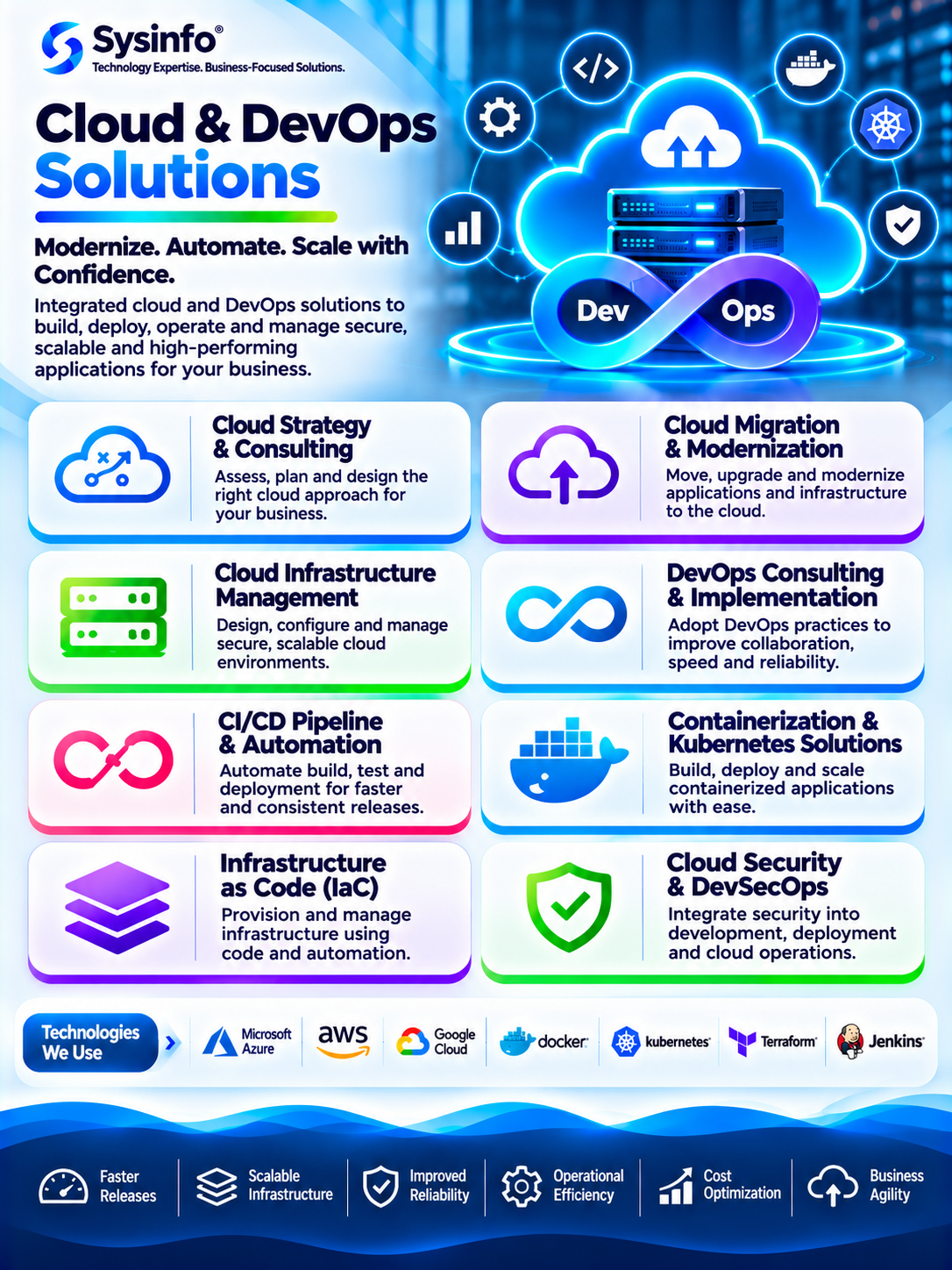
Cloud and DevOps solutions help organizations build, deploy, operate, and maintain applications and IT infrastructure using modern technologies and collaborative engineering practices.
Cloud computing provides access to computing resources such as servers, storage, databases, networking, and application platforms through cloud environments. It can help businesses manage infrastructure more flexibly without depending entirely on traditional on-premises systems.
DevOps brings software development and IT operations closer together through collaboration, automation, continuous integration, continuous delivery, monitoring, and consistent deployment practices.
When used together, cloud and DevOps practices can help organizations improve how they develop, release, and operate software.
These solutions may involve:
Cloud infrastructure planning and configuration
Cloud migration and application modernization
Infrastructure provisioning and management
DevOps strategy and implementation
Continuous Integration and Continuous Delivery (CI/CD)
Containerization and orchestration
Infrastructure as Code (IaC)
Cloud monitoring and performance management
Security integration and operational governance
Ongoing infrastructure maintenance and optimization
At Sysinfo, we consider your existing technology environment, application architecture, operational needs, and business priorities when planning cloud and DevOps solutions.
Moving to the cloud or changing an existing cloud environment requires careful planning. Businesses need to understand their workloads, application dependencies, infrastructure requirements, security considerations, and operational objectives before making major technology decisions.
Sysinfo supports cloud planning and consulting to help organizations evaluate their current environments and identify suitable cloud adoption strategies.
Our cloud consulting support may include:
Cloud readiness assessment
Existing infrastructure evaluation
Application and workload assessment
Cloud adoption planning
Cloud architecture recommendations
Technology and platform evaluation
Migration roadmap preparation
Infrastructure cost considerations
Security and governance planning
We focus on understanding your business requirements before recommending a cloud approach. This helps ensure that technology decisions are based on actual application and operational needs rather than trends alone.
A well-planned cloud infrastructure provides the foundation for hosting applications, managing data, supporting users, and handling changing workloads.
Sysinfo supports cloud infrastructure planning and management based on application requirements, workload patterns, and operational expectations.
Our cloud infrastructure services may include:
Cloud infrastructure architecture
Virtual machine and compute configuration
Cloud storage planning
Network and connectivity configuration
Cloud database infrastructure
Environment setup and configuration
Resource provisioning
Infrastructure management
Capacity and performance planning
Infrastructure documentation
We consider availability, security, scalability, and maintainability when planning cloud environments.
Businesses often need to move applications, databases, and infrastructure from traditional environments to cloud platforms. A migration project requires more than transferring files or servers. It involves understanding application dependencies, data requirements, compatibility, and potential operational risks.
Sysinfo supports cloud migration and modernization activities to help organizations transition their existing technology environments.
Our cloud migration support may include:
Cloud migration assessment
Application dependency analysis
Infrastructure migration planning
Server and workload migration
Database migration support
Application rehosting
Application platform modernization
Cloud configuration and integration
Migration testing and validation
Post-migration support
Depending on the application, migration may involve rehosting, replatforming, refactoring, replacing, or retaining specific components.
We evaluate the existing environment and business requirements before identifying an appropriate migration strategy.
DevOps is not simply a collection of tools. It is an approach that encourages collaboration between development and operations teams, supported by automation and consistent engineering practices.
Sysinfo supports DevOps implementation to help organizations improve their software delivery workflows and infrastructure operations.
Our DevOps services may include:
DevOps readiness assessment
Existing development workflow evaluation
DevOps strategy and roadmap
Development and operations workflow alignment
Build and release process improvement
Automation planning
Environment standardization
Deployment workflow design
DevOps toolchain integration
Continuous improvement recommendations
We focus on identifying practical improvements that fit your team's working methods, application architecture, and release requirements.
Continuous Integration and Continuous Delivery or Deployment help teams automate important stages of the software release lifecycle.
A well-designed CI/CD pipeline can help developers integrate code changes, run automated checks, package applications, and prepare or deploy releases through a more consistent process.
Sysinfo supports CI/CD pipeline design and implementation for applications with suitable development and deployment requirements.
Our CI/CD services may include:
Continuous Integration pipeline setup
Continuous Delivery workflow development
Automated build configuration
Automated testing integration
Code quality checks
Application packaging
Deployment automation
Release workflow configuration
Environment-specific deployment
Pipeline troubleshooting and optimization
We design pipelines around your application's architecture, testing requirements, release process, and deployment environments.
Managing infrastructure manually can become complicated when environments need to be created, updated, or maintained repeatedly.
Infrastructure as Code allows infrastructure configurations to be defined and managed through code or configuration files. This helps teams maintain consistency and review infrastructure changes in a structured manner.
Our Infrastructure as Code support may include:
Infrastructure provisioning automation
Infrastructure configuration management
Reusable infrastructure templates
Environment configuration
Version-controlled infrastructure definitions
Automated resource deployment
Infrastructure change management
Configuration validation
Infrastructure documentation
Depending on the project, suitable tools and frameworks can be selected to manage infrastructure provisioning and configuration.
Applications often need consistent deployment environments across development, testing, and production. Containerization helps package applications and their dependencies into portable units that can run in supported environments.
For applications with more complex deployment and scaling requirements, container orchestration can help manage containerized workloads.
Sysinfo supports containerization and orchestration initiatives based on your application architecture.
Our services may include:
Application containerization
Docker-based environment configuration
Container image management
Container deployment workflows
Kubernetes environment planning
Container orchestration support
Application configuration management
Container monitoring
Deployment troubleshooting
Container environment maintenance
We evaluate whether containerization and orchestration are suitable for your application rather than introducing additional infrastructure complexity without a clear need.
Cloud-native applications are designed or adapted to make effective use of cloud environments. They may use distributed architecture, microservices, containers, managed services, and automated deployment practices.
Sysinfo supports cloud-native development and deployment initiatives for organizations planning new applications or modernizing existing systems.
Our cloud-native capabilities may include:
Cloud-native application architecture
Microservices-based application design
API-driven application development
Container-based deployment
Cloud service integration
Application configuration management
Automated build and deployment
Distributed application monitoring
Application scalability planning
Cloud-native modernization
The architecture is selected according to application requirements, operational complexity, and long-term maintenance considerations.
Security should be considered throughout the software development and infrastructure lifecycle. Integrating security checks into development and deployment workflows can help teams identify potential issues earlier.
Sysinfo supports security-focused cloud and DevOps practices that consider application, infrastructure, configuration, and access requirements.
Our support may include:
Cloud security configuration reviews
Identity and access management planning
Role-based access controls
Secure configuration practices
Secrets and credential management
Security checks within CI/CD workflows
Dependency and code scanning integration
Container security considerations
Infrastructure configuration validation
Security monitoring integration
Security requirements vary by application, industry, and regulatory environment. The appropriate controls and validation processes should be defined for each project.
Once an application is deployed, teams need visibility into its performance, availability, resource usage, and operational behavior.
Monitoring and logging help identify unusual activity, investigate errors, understand application performance, and support operational decision-making.
Sysinfo supports cloud monitoring and operational visibility initiatives that may include:
Infrastructure monitoring configuration
Application performance monitoring
Log collection and management
Centralized logging integration
Resource utilization monitoring
Alert configuration
Availability monitoring
Performance analysis
Operational reporting
Troubleshooting support
We help define monitoring requirements based on the application, infrastructure, service expectations, and operational responsibilities.
Manual operational tasks can consume time and create inconsistencies across environments. Automation helps teams standardize repeatable processes and reduce unnecessary manual intervention.
Sysinfo supports automation initiatives across development, deployment, and infrastructure operations.
Our automation services may include:
Infrastructure provisioning automation
Environment configuration automation
Build and release automation
Deployment scripting
Configuration management
Automated application updates
Repetitive task automation
Environment synchronization
Operational workflow improvements
Automation documentation
We identify automation opportunities based on process frequency, technical feasibility, operational risk, and expected value.
Cloud environments and application infrastructure require ongoing attention after implementation. Resource changes, application updates, configuration requirements, and operational issues can create the need for continuous management.
Sysinfo provides infrastructure management and related support based on the agreed service scope.
Our infrastructure management support may include:
Cloud infrastructure administration
Server and environment management
Configuration updates
Infrastructure troubleshooting
Resource utilization reviews
Performance monitoring support
Backup and recovery planning
Deployment assistance
Technical documentation
Infrastructure maintenance
Support responsibilities, service hours, escalation arrangements, and response expectations should be defined according to your organization's operational requirements.
A successful cloud or DevOps initiative requires a clear understanding of the current environment, business goals, technical dependencies, and operational expectations.
At Sysinfo, the implementation approach can be organized into the following stages.
Step 1: Discovery and Requirement Assessment
We begin by understanding your existing infrastructure, applications, development workflows, business objectives, security requirements, and operational challenges.
Step 2: Environment Assessment and Planning
We evaluate application dependencies, infrastructure requirements, workloads, and technology options. Based on the findings, we prepare a suitable implementation or migration plan.
Step 3: Architecture and Solution Design
We define the cloud architecture, infrastructure components, deployment approach, integration requirements, and operational responsibilities.
Step 4: Infrastructure Setup and Configuration
We configure the required environments, resources, networking, access controls, and infrastructure components according to the agreed design.
Step 5: DevOps Automation and CI/CD Implementation
Where required, we introduce build automation, testing workflows, deployment pipelines, infrastructure automation, and configuration management.
Step 6: Testing and Validation
We validate application functionality, deployment workflows, infrastructure configurations, integrations, and relevant performance and security requirements.
Step 7: Deployment and Transition
We prepare the environment for production use and support the agreed deployment or migration process. Documentation and operational handover can be included in the transition.
Step 8: Monitoring and Continuous Improvement
After implementation, we can support monitoring, troubleshooting, infrastructure reviews, automation improvements, and ongoing optimization.
The exact stages, deliverables, and responsibilities depend on your infrastructure, application complexity, migration scope, and selected engagement model.
Selecting a cloud and DevOps partner requires more than choosing someone who can configure servers or install automation tools. You need an approach that considers your applications, infrastructure, development processes, and business objectives together.
Sysinfo focuses on practical technology solutions designed around your organization’s requirements.
We begin by understanding your operational goals and technical challenges. This helps connect cloud and DevOps decisions with the outcomes your business needs.
Cloud infrastructure, application deployment, automation, and monitoring are closely connected. We consider these areas together when planning a solution.
Different applications and organizations require different platforms and tools. We evaluate technology options based on compatibility, workload requirements, technical suitability, and long-term maintenance.
We identify suitable opportunities to automate repeatable development and infrastructure activities, helping teams establish more consistent processes.
Security, testing, configuration validation, and monitoring should be considered throughout implementation rather than added only at the end.
Requirement discussions, documented plans, progress reviews, and clear responsibilities help keep technical teams and business stakeholders aligned.
Cloud environments and DevOps workflows evolve over time. We can discuss ongoing infrastructure support, maintenance, monitoring, and improvement based on your operational needs.

A well-planned cloud and DevOps approach can help organizations improve the way they develop, deploy, and operate applications.
Potential benefits include:
Cloud environments can provide access to computing, storage, and networking resources that can be configured according to application and workload requirements.
CI/CD pipelines and deployment automation can help standardize release activities and reduce repetitive manual steps.
DevOps practices encourage development and operations teams to work with shared processes, responsibilities, and delivery objectives.
Monitoring, logging, and alerting can help teams understand infrastructure behavior and investigate operational issues.
Automation can simplify repeatable tasks such as infrastructure provisioning, application builds, configuration, and deployments.
Suitable cloud architecture and resource planning can help applications accommodate changing workloads. Actual scalability depends on architecture, configuration, and workload characteristics.
Integrating security reviews and automated checks into development and deployment workflows can help teams identify certain risks earlier.
Infrastructure definitions, configuration management, and standardized deployment processes can make development, testing, and production environments easier to manage consistently.
Actual cost savings, release improvements, performance, and operational outcomes depend on your existing environment, implementation quality, workload patterns, and ongoing management.
The right cloud and DevOps technology stack depends on your applications, existing infrastructure, development environment, security requirements, and operational goals.
Depending on the project scope, cloud and DevOps initiatives may involve the following technologies and capabilities:
Cloud Platforms: Microsoft Azure, Amazon Web Services (AWS), and Google Cloud Platform (GCP), where suitable for the project.
Containers: Docker and container-based application environments.
Container Orchestration: Kubernetes and related orchestration technologies.
CI/CD: Azure DevOps, Jenkins, GitHub Actions, GitLab CI/CD, and other suitable pipeline tools.
Infrastructure as Code: Terraform and cloud-native infrastructure templates.
Configuration Management: Ansible and other suitable configuration management tools.
Version Control: Git and collaborative source-code management workflows.
Scripting and Automation: PowerShell, Bash, Python, and other suitable automation technologies.
Monitoring and Logging: Prometheus, Grafana, ELK-based tools, and cloud-native monitoring services.
Application Technologies: .NET, ASP.NET Core, Java, Spring Boot, PHP, and other supported application environments.
Not every project needs every tool. We recommend selecting technologies according to the application’s architecture, team capabilities, existing investments, and long-term operational requirements.
Your infrastructure and software delivery processes should support your business—not make growth and innovation more difficult.
Whether you are planning to move applications to the cloud, modernize existing infrastructure, introduce CI/CD automation, containerize applications, or improve your DevOps practices, Sysinfo can discuss your requirements and help identify a suitable technical approach.
Tell us about your current infrastructure, application environment, or cloud migration plans. Let’s explore how Cloud & DevOps Solutions can support your business.
Cloud and DevOps requirements vary across industries. Some organizations prioritize application availability, while others focus on deployment automation, infrastructure modernization, data management, or distributed development environments.
Our solutions may support:
Cloud-hosted applications, automated build and deployment workflows, development environments, and application infrastructure management.
Cloud-hosted learning platforms, application infrastructure, user access environments, and deployment management.
Infrastructure modernization, controlled deployment workflows, monitoring, and security-focused operational processes, subject to applicable regulatory requirements.
Business application hosting, infrastructure modernization, operational dashboards, and system integration environments.
Cloud infrastructure and application environments that consider data protection, access controls, availability, and relevant healthcare compliance requirements.
Cloud-based business applications, internal platforms, infrastructure management, and automated software delivery workflows.
Cloud-based commerce platforms, application deployment automation, infrastructure monitoring, and workload management.
The solution scope and applicable compliance requirements are evaluated according to each organization’s technology environment and business needs.
Cloud and DevOps solutions combine cloud infrastructure, application deployment, automation, monitoring, and development operations practices. They help organizations manage applications and infrastructure while improving software delivery workflows.
Cloud computing provides infrastructure and services such as computing, storage, networking, and databases through cloud platforms. DevOps focuses on collaboration, automation, testing, and deployment practices that connect software development with IT operations. They can work together to support modern application delivery.
Common cloud platforms include Microsoft Azure, Amazon Web Services (AWS), and Google Cloud Platform (GCP). The appropriate platform depends on application requirements, existing technology investments, workload characteristics, security needs, and budget considerations.
Cloud migration support may include infrastructure assessment, application dependency analysis, migration planning, workload migration, database migration support, testing, and post-migration assistance. The approach depends on the existing application and target environment.
DevOps implementation involves introducing practices and tools that improve collaboration between development and operations teams. It may include CI/CD pipelines, automated testing, infrastructure automation, configuration management, monitoring, and deployment improvements.
A CI/CD pipeline automates selected stages of the software delivery process. It can include code integration, builds, automated testing, application packaging, and deployment. The pipeline is configured according to the application's technology stack and release requirements.
Infrastructure as Code (IaC) is a method of managing infrastructure through machine-readable definitions and configuration files. It helps teams provision and maintain infrastructure in a more repeatable and reviewable way.
Docker is commonly used to package applications and their dependencies into containers. Kubernetes helps manage containerized applications across supported infrastructure environments, including deployment, scaling, and orchestration.
Automation can reduce repetitive manual steps, standardize deployment workflows, and support consistent release processes. The actual improvement depends on the quality of the pipeline, testing practices, application architecture, and team workflow.
DevSecOps integrates security considerations into software development and operations workflows. It can involve automated security checks, dependency scanning, access management, secure configuration, and infrastructure validation throughout the delivery lifecycle.
Yes. Monitoring helps teams observe infrastructure resources, application performance, availability, logs, and operational events. The monitoring scope should reflect the application's service requirements and operational responsibilities.
Cloud infrastructure management support can be planned around your existing environment. It may include configuration management, monitoring support, troubleshooting, resource reviews, maintenance, and documentation, depending on the agreed service scope.
The timeline depends on infrastructure size, application complexity, dependencies, migration strategy, security requirements, automation scope, and testing needs. A technical assessment helps establish a realistic implementation plan.
Costs vary according to the cloud platform, infrastructure requirements, application complexity, migration scope, tools, engineering effort, and ongoing support needs. A review of your requirements helps establish a suitable estimate.
Share your current infrastructure details, application requirements, cloud migration objectives, development workflow, and business priorities. Sysinfo can then discuss the project scope and potential next steps.
Copyright © 2026 Sysinfo Solutions