Successful outsourcing begins with understanding your business—not simply assigning tasks to an external team. The right outsourcing strategy considers your business objectives, technical requirements, operational challenges, team structure, security needs, and long-term plans.
At Sysinfo, our outsourcing approach focuses on creating a clear path from initial assessment to implementation, service delivery, and continuous improvement. We work to establish practical processes, transparent communication, defined responsibilities, and measurable expectations that help outsourced teams work effectively with your organization.
Whether you are outsourcing software development, application testing, IT support, offshore staffing, or selected business processes, our approach is designed around your requirements and the outcomes you want to achieve.
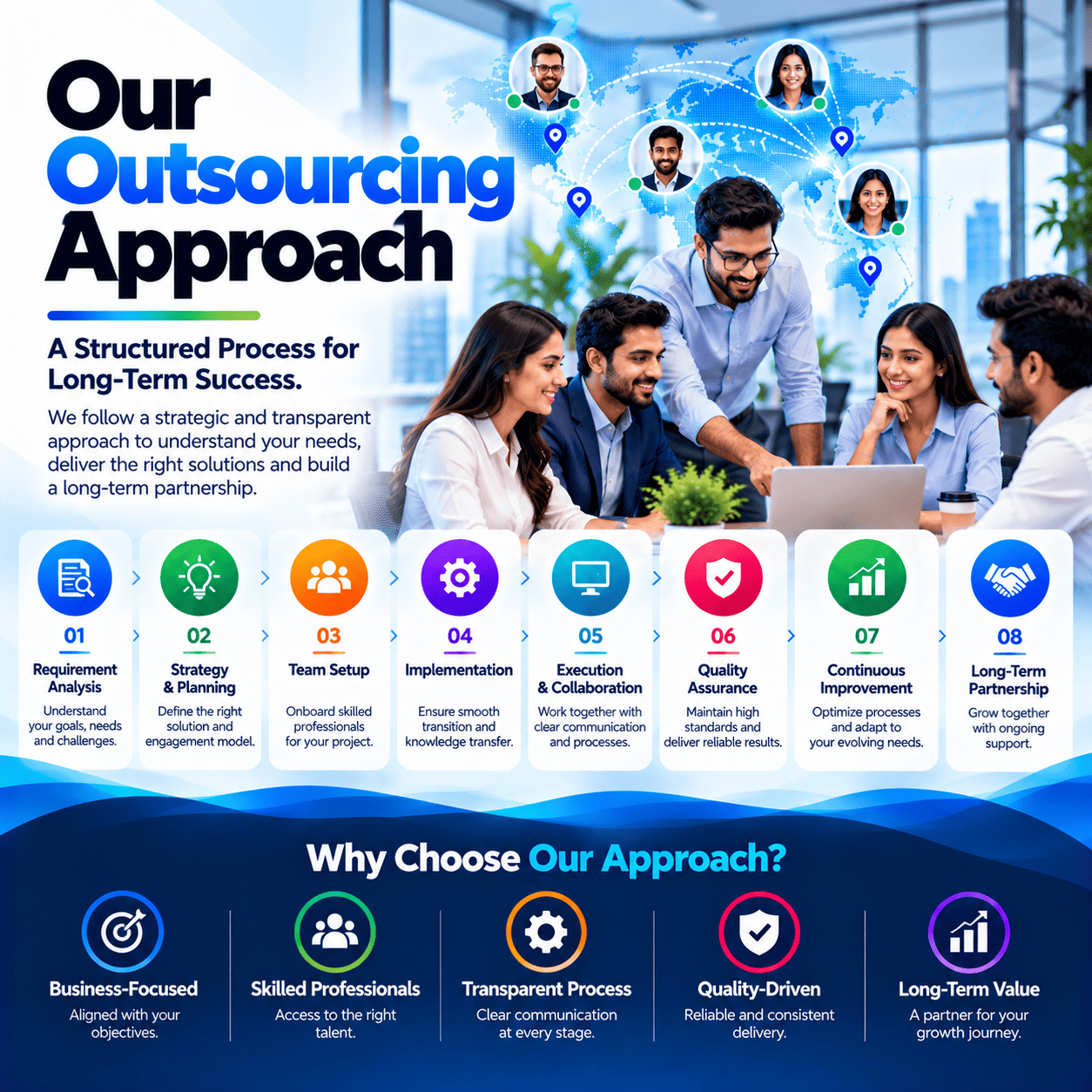
Before recommending an outsourcing arrangement, it is important to understand which activities are suitable for external support and how outsourcing can contribute to your business goals.
Our assessment considers:
Your business objectives and operational priorities.
Current workflows and recurring challenges.
Activities that may benefit from outsourcing.
Skills and capabilities available internally.
Required technical expertise and resources.
Expected workload, deadlines, and deliverables.
Potential operational, security, and transition risks.
Opportunities to improve processes or introduce automation.
The outcome is a clearer understanding of your requirements and a practical foundation for planning the engagement.
Once the requirements are understood, we help define an outsourcing solution that fits your organization.
Planning may include:
Defining the service scope and expected outcomes.
Identifying required skills and responsibilities.
Selecting an appropriate delivery model.
Establishing communication and reporting procedures.
Defining project milestones and priorities.
Identifying tools, environments, and system access requirements.
Establishing quality standards and acceptance criteria.
Agreeing on relevant security and confidentiality requirements.
A well-defined plan helps both parties understand what will be delivered, how progress will be measured, and who is responsible for each activity.
Moving work to an external team requires careful coordination. Incomplete documentation, unclear ownership, or insufficient knowledge transfer can delay delivery and create unnecessary risks.
Sysinfo’s transition planning can include:
Preparing an implementation roadmap.
Organizing technical and operational documentation.
Coordinating knowledge transfer.
Defining team responsibilities and escalation paths.
Setting up approved tools and working environments.
Establishing communication channels.
Planning onboarding and initial task allocation.
Identifying transition dependencies and risks.
Where appropriate, a pilot phase can be used to validate the process before the engagement expands.
Outsourcing works best when the external team understands your objectives and can collaborate effectively with internal stakeholders.
Our approach emphasizes:
Clear task ownership.
Regular project and operational updates.
Documented requirements and decisions.
Defined review and approval processes.
Consistent communication channels.
Timely escalation of blockers.
Knowledge sharing between teams.
Alignment with agreed development or business workflows.
For software projects, collaboration can be organized around Agile practices, sprint planning, code reviews, testing, and release coordination when suitable.
Quality should be considered throughout the engagement rather than checked only at the end.
Depending on the service, quality practices may include:
Documented standard operating procedures.
Code reviews and technical validation.
Software testing and defect tracking.
Data verification and processing checks.
Deliverable reviews against acceptance criteria.
Performance and operational reporting.
Issue tracking and corrective actions.
Documentation and knowledge maintenance.
The appropriate checks depend on the type of work, business risks, and agreed quality expectations.
Outsourcing often involves access to business systems, application code, operational information, or customer data. These responsibilities should be defined before work begins.
Our approach encourages clear arrangements for:
Confidentiality and information handling.
Role-based access and least-privilege permissions.
Approved data transfer and storage methods.
Intellectual property and ownership terms.
Security review and incident escalation.
Documentation and audit requirements.
Access removal when responsibilities change.
Applicable contractual and regulatory obligations.
Security controls should be appropriate to the engagement and agreed by the relevant stakeholders.
Regular reporting helps both parties understand progress, identify issues, and make informed decisions.
Depending on the engagement, performance indicators may include:
Milestone completion.
Task throughput and turnaround time.
Defect rates and rework.
Testing coverage and unresolved issues.
Service-level adherence.
Operational backlog.
Resource utilization.
Stakeholder feedback.
Progress against agreed business objectives.
Metrics should be selected according to the service being delivered rather than applying the same measurements to every engagement.
Business needs and technology requirements change over time. We encourage regular reviews to identify opportunities to improve delivery and address emerging challenges.
Improvement activities may include:
Reviewing recurring issues and bottlenecks.
Refining workflows and documentation.
Improving collaboration and reporting.
Automating suitable repetitive activities.
Reviewing resource requirements.
Updating testing and quality practices.
Incorporating stakeholder feedback.
Adjusting priorities as business needs evolve.
The objective is to help the outsourcing relationship remain useful, transparent, and aligned with your changing requirements.
Requirement-driven planning
Begin with your actual business needs and challenges.
Defined responsibilities
Establish ownership, deliverables, and escalation procedures.
Structured implementation
Plan onboarding, knowledge transfer, and transition activities.
Quality-focused execution
Use suitable validation and review practices.
Clear communication
Maintain alignment between internal and external teams.
Security-conscious processes
Define access, confidentiality, and data handling expectations.
Flexible delivery
Adapt the working arrangement to project and operational requirements.
Continuous improvement
Use feedback and performance data to refine processes.
Sysinfo can help you evaluate outsourcing opportunities, define a practical implementation plan, and establish processes that support your business goals.
Contact Sysinfo to discuss an outsourcing approach tailored to your organization.
An outsourcing approach is the method used to assess requirements, plan the engagement, transition work, manage delivery, monitor quality, and improve the working relationship.
The process begins with understanding your business objectives, current challenges, required skills, expected deliverables, and operating constraints. This information helps define the scope and suitable engagement model.
Transition planning helps reduce confusion, protect important knowledge, establish responsibilities, and prepare systems and workflows before outsourced work begins.
Quality can be supported through defined acceptance criteria, documented processes, testing, reviews, defect tracking, and regular performance reporting.
Yes. The approach should reflect the type of service, project complexity, business requirements, risk profile, and expected level of collaboration.
Copyright © 2026 Sysinfo Solutions