Modern software development requires more than building applications quickly. Businesses also need to protect sensitive data, identify vulnerabilities early, secure cloud infrastructure, and maintain reliable software delivery without slowing down development.
Sysinfo provides DevSecOps services that integrate security into every stage of the software development lifecycle from planning and coding to testing, deployment, monitoring, and ongoing operations.
Traditional development workflows often treat security as a final checkpoint before an application goes live. DevSecOps takes a different approach by bringing development, security, release management, and operations together. Security checks become part of everyday development activities, helping teams identify and address potential risks earlier.
At Sysinfo, we help businesses implement practical DevSecOps practices that support secure coding, automated security testing, vulnerability management, cloud security, infrastructure protection, and secure CI/CD pipelines.
Whether you are developing a new application, modernizing an enterprise platform, deploying cloud-native software, or strengthening an existing DevOps process, our DevSecOps consulting and implementation services help make security a continuous part of software delivery.
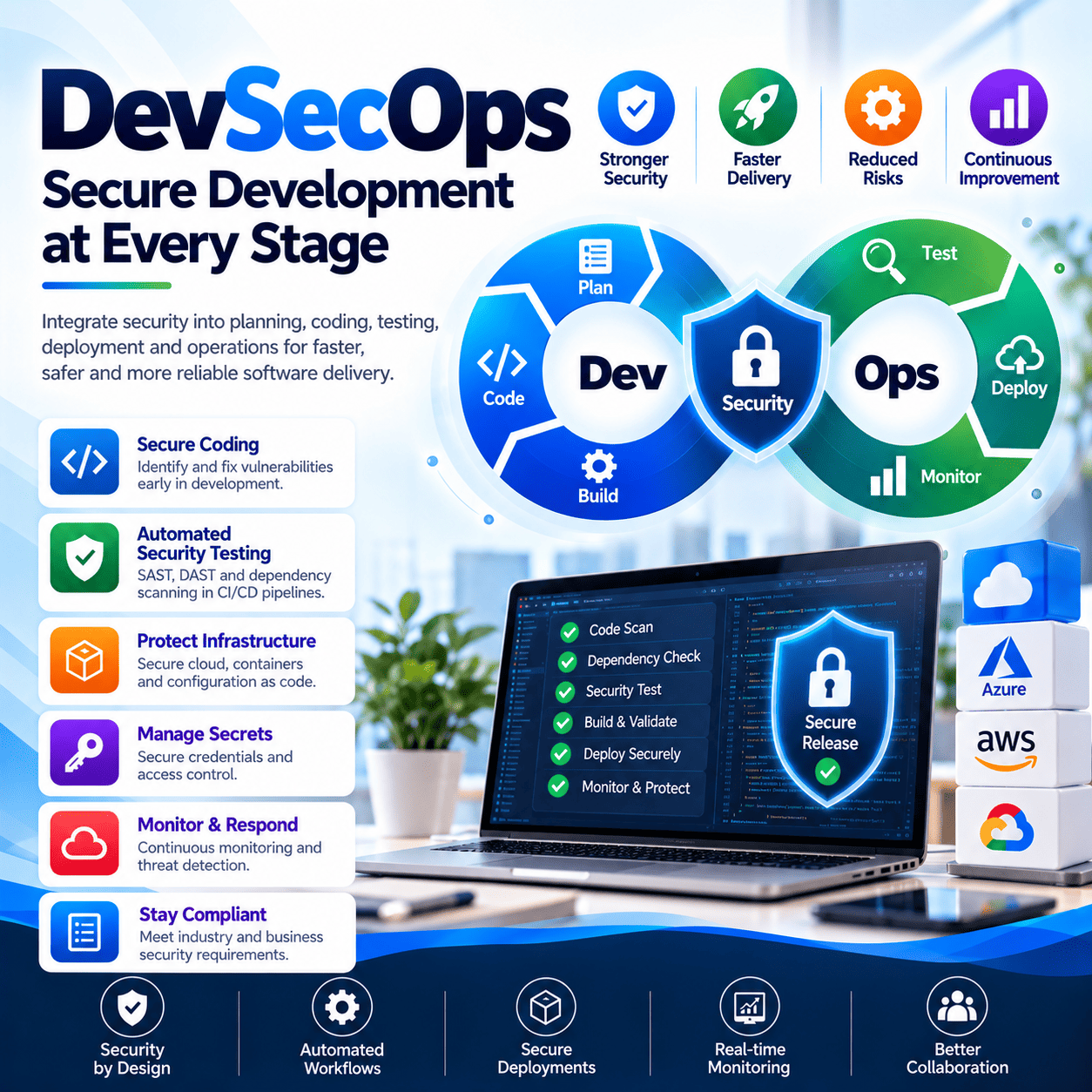
DevSecOps stands for Development, Security, and Operations. It extends DevOps practices by integrating security controls, testing, and risk management throughout the software delivery lifecycle.
Instead of waiting until the end of development to perform security checks, DevSecOps encourages teams to identify, assess, and address security issues as early as possible.
A typical DevSecOps workflow includes:
Plan → Code → Build → Test → Secure → Release → Deploy → Monitor → Improve
Security is not limited to one stage. It is considered throughout the entire process, with controls selected according to the application’s architecture, business requirements, and risk profile.
A well-designed DevSecOps approach can help organizations:
Detect security vulnerabilities earlier.
Automate repeatable security checks.
Protect application source code and dependencies.
Reduce risks associated with insecure configurations.
Secure cloud infrastructure and container images.
Improve visibility into security findings.
Strengthen deployment and release controls.
Support compliance and audit requirements.
Respond to vulnerabilities more efficiently.
Maintain a better balance between development speed and security.
The goal is not to eliminate every possible security risk. It is to make security more consistent, measurable, and manageable throughout software development and operations.
Every business has different security risks, development workflows, and compliance requirements. Our DevSecOps consulting services help you understand where security gaps exist and how security practices can be integrated into your existing software delivery process.
Our services include:
DevSecOps maturity assessment
Secure development workflow design
Security policy and standards planning
Risk assessment and prioritization
Security tool selection and integration
CI/CD security strategy
Secure release planning
Developer and operations collaboration
Continuous security improvement
We focus on practical changes that strengthen security without adding unnecessary complexity to everyday development work.
Application security begins during planning and coding. Addressing security requirements early helps developers make better architectural decisions and avoid common vulnerabilities.
Our secure software development services include:
Secure coding practices
Application security reviews
Input validation
Authentication and authorization
Secure session management
API security
Data protection
Error handling
Secure configuration
Code review and remediation
We help teams incorporate security into development standards so that developers can identify common weaknesses before code reaches production.
CI/CD pipelines automate how software is built, tested, and deployed. If pipelines are not properly protected, unauthorized access, exposed credentials, or compromised build processes can create serious risks.
Our DevSecOps pipeline security services include:
Pipeline access control
Secure build agents
Protected repositories and branches
Automated security scanning
Secret detection
Dependency vulnerability checks
Deployment approvals
Secure artifact management
Pipeline audit logging
Production environment protection
We help establish security controls across the software delivery workflow, including the tools and infrastructure used to build and deploy applications.
SAST analyzes source code or compiled representations to identify potential security weaknesses without requiring the application to be running.
Our SAST services can include:
Static code analysis integration
Security rules and policy configuration
Automated code scanning
Pull request security checks
Vulnerability prioritization
False-positive review
Remediation guidance
Security reporting
SAST can help identify issues such as insecure coding patterns, unsafe data handling, and potential injection vulnerabilities early in development.
DAST tests a running application from the outside to identify potential weaknesses in its behavior and exposed interfaces.
Our DAST services include:
Web application security testing
Running application vulnerability scans
API security testing
Authentication and session testing
Configuration checks
Security test automation
Vulnerability verification
Remediation recommendations
Retesting after fixes
DAST complements static analysis by assessing the running application rather than relying only on source code. The appropriate testing scope depends on the application and its risk profile.
Modern applications frequently use open-source packages, third-party libraries, frameworks, and external components. These dependencies can introduce vulnerabilities if they are outdated or improperly managed.
Our software composition analysis services include:
Open-source dependency scanning
Known vulnerability detection
Dependency inventory
Package version assessment
License risk identification
Dependency update planning
Remediation prioritization
Software Bill of Materials (SBOM) support
Dependency policy integration
We help organizations understand which components they use and establish a repeatable process for identifying and addressing dependency-related risks.
Passwords, API keys, access tokens, database credentials, and certificates must be handled carefully throughout development and deployment.
Our secrets management services include:
Secret scanning in repositories
Removal of exposed credentials
Secure storage integration
Environment variable management
Credential rotation planning
Restricted secret access
Managed identity integration
Secure pipeline authentication
Access auditing
Where appropriate, we can integrate services such as Azure Key Vault or equivalent secret management platforms to reduce the need to store credentials directly in source code or configuration files.
Cloud environments need appropriate access controls, network configuration, logging, encryption, and workload protection.
Our cloud DevSecOps services include:
Cloud security configuration reviews
Identity and access management
Least-privilege access policies
Network security controls
Storage security
Encryption configuration
Cloud workload protection
Secure resource provisioning
Security monitoring
Configuration drift identification
We support security practices for Microsoft Azure, AWS, and Google Cloud environments, depending on the project requirements.
Infrastructure as Code makes it possible to manage cloud infrastructure through version-controlled definitions. However, insecure templates can reproduce the same misconfiguration across multiple environments.
Our IaC security services include:
Infrastructure template scanning
Cloud configuration validation
Secure resource definitions
Network exposure checks
Identity permission reviews
Encryption configuration checks
Policy enforcement
Infrastructure change reviews
Secure provisioning pipelines
We can incorporate security validation into infrastructure deployment workflows using suitable tools and platform policies.
Containers and Kubernetes environments introduce specific security considerations, including image vulnerabilities, excessive permissions, exposed services, and insecure runtime configurations.
Our container security services include:
Container image vulnerability scanning
Base image assessment
Image version management
Container configuration reviews
Kubernetes access control
Workload security policies
Secret handling
Network policy configuration
Image registry security
Runtime monitoring
These controls help protect containerized applications throughout development, deployment, and operations.
A secure application delivery environment should ensure that users, services, developers, and automated pipelines have only the permissions they need.
Our identity and access management services include:
Role-based access control
Multi-factor authentication integration
Least-privilege permissions
Service identity management
Secure pipeline authentication
Privileged access reviews
Repository permission management
Access logging
Credential lifecycle management
We help organizations establish clearer access boundaries across development tools, cloud environments, and production systems.
Security does not end after an application is deployed. Production systems need continuous visibility into suspicious activity, configuration changes, errors, and emerging vulnerabilities.
Our monitoring services include:
Security event logging
Application and infrastructure monitoring
Alert configuration
Vulnerability tracking
Incident investigation support
Suspicious activity detection
Security dashboard configuration
Log retention planning
Incident response workflow support
Remediation tracking
We help teams connect security monitoring with operational workflows so that findings can be investigated and addressed in a structured way.
Businesses may need to demonstrate that appropriate security controls are implemented and reviewed. DevSecOps practices can support these efforts by creating repeatable checks and useful records of development and deployment activity.
Our compliance support services can include:
Security policy implementation support
Audit trail configuration
Access review documentation
Vulnerability reports
Dependency inventory reports
Security testing evidence
Deployment approval records
Change tracking
Remediation status reporting
Compliance control mapping support
The exact requirements depend on your industry, applicable regulations, and chosen security framework. DevSecOps implementation alone does not guarantee compliance or certification.
We review your application architecture, source code repositories, CI/CD pipelines, cloud infrastructure, development tools, and current security controls.
We identify potential weaknesses across application code, dependencies, credentials, infrastructure, access permissions, and deployment processes.
We establish priorities based on business risk, application exposure, technical requirements, and existing development workflows.
We introduce suitable secure coding practices, code reviews, threat modeling, and developer-focused security checks.
We integrate appropriate static analysis, dynamic testing, dependency scanning, secret detection, and infrastructure checks into the delivery process.
We review pipeline permissions, service identities, credentials, build processes, artifacts, approval requirements, and production deployment access.
Where applicable, we implement secure infrastructure configurations, container scanning, identity controls, and workload protection.
We establish appropriate security logging, alerts, dashboards, vulnerability reporting, and remediation tracking.
We verify that the configured controls work as expected and that findings can be investigated and resolved through a defined process.
We support ongoing vulnerability management, configuration reviews, tool updates, policy improvements, and security process optimization.
We help incorporate security into planning, architecture, coding, testing, release management, and operations instead of treating it as a final checkpoint.
We identify suitable opportunities to automate code scanning, dependency checks, secret detection, infrastructure validation, and security testing.
We help protect the workflows that build and deploy your applications through access controls, security checks, approvals, and auditability.
Our DevSecOps approach considers application code, APIs, cloud infrastructure, containers, identities, dependencies, and deployment environments.
We support DevSecOps practices for .NET, ASP.NET Core, Azure, Azure DevOps, GitHub, and related Microsoft technologies, while remaining flexible about the tools your business uses.
Not every security finding carries the same risk. We help teams assess findings according to severity, exposure, business impact, and remediation requirements.
Security checks should provide useful feedback and clear remediation guidance. We aim to integrate controls into existing developer workflows wherever practical.
We help establish monitoring and reporting practices that provide better visibility into application security and operational issues after deployment.
DevSecOps can be introduced gradually into established systems. We help identify suitable starting points and prioritize improvements based on current risks.
Threats, application dependencies, cloud environments, and business requirements change over time. We support continued reviews and improvements rather than treating security as a one-time implementation.
Sysinfo can work with suitable tools based on your existing technology stack, cloud platform, and security requirements.
GitHub, GitLab, Azure Repos, Azure Pipelines, GitHub Actions, Jenkins
GitHub CodeQL, static analysis tools, SAST, DAST, API security testing
Software composition analysis, dependency scanning, SBOM tools, package and license checks
Azure Key Vault, managed identities, role-based access control, secure credential stores
Microsoft Azure, AWS, Google Cloud, cloud security posture and workload protection tools
Terraform, Azure Bicep, Docker, Kubernetes, Helm, infrastructure scanning tools
Azure Monitor, Microsoft Defender for Cloud, security logging platforms, alerting and incident management tools
Integrate security checks into .NET builds, API testing, dependency management, CI/CD workflows, and Azure deployments. Improve secure coding practices and protect application configuration and credentials.
Introduce static analysis, dependency scanning, API security checks, secure configuration, container scanning, and automated security validation into Java development and release workflows.
Secure microservices, containers, Kubernetes deployments, cloud identities, infrastructure definitions, and application monitoring throughout the lifecycle.
Improve access controls, software dependency visibility, release approvals, security reporting, and deployment governance across complex application environments.
Protect customer data, APIs, application identities, deployment pipelines, cloud resources, and third-party components as the product evolves.
Gradually introduce source control improvements, automated testing, vulnerability scanning, secure configuration, and stronger deployment controls without requiring an immediate full application rewrite.

Choosing the right Oracle solution can provide your business with a strong foundation for managing data and enterprise applications.
Security testing during development helps identify potential weaknesses before they progress to production.
Repeated security checks can run automatically within development, testing, and deployment pipelines.
Secure coding practices, code reviews, and automated analysis help teams address common weaknesses.
Identity controls, configuration validation, and workload security practices help reduce cloud-related risks.
Software composition analysis helps teams identify vulnerable third-party packages and manage dependency updates.
Centralized secrets management and restricted access help reduce the risk of exposed credentials.
Version control, pipeline records, access logs, and security reports can support internal reviews and compliance efforts.
Automated checks and defined release controls help teams make more informed deployment decisions.
DevSecOps cannot guarantee that an application will never be compromised. Its value lies in improving prevention, detection, response, and recovery through continuous security practices.
Security should not be something businesses think about only when an application is ready to launch. It should be part of the decisions made during planning, development, testing, deployment, and everyday operations.
Sysinfo helps businesses integrate security into their software delivery lifecycle through DevSecOps consulting, automated security testing, secure CI/CD pipelines, cloud security, dependency management, infrastructure protection, and continuous monitoring.
Whether you are building a new application, strengthening an existing DevOps workflow, modernizing enterprise software, or protecting cloud-native workloads, we can help you develop a practical security strategy that fits your technology environment and business needs.
Contact Sysinfo to discuss your DevSecOps requirements and make security a continuous part of your software development process.
DevSecOps services integrate security into software planning, coding, testing, release management, deployment, and operations. They can include secure coding, automated security testing, vulnerability management, cloud security, secrets management, and CI/CD security.
DevOps focuses on collaboration and automation across software development and operations. DevSecOps builds on those practices by making security an integrated responsibility throughout the software lifecycle rather than a separate final-stage activity.
Modern applications use frequent releases, cloud services, APIs, and third-party dependencies. DevSecOps helps teams identify security issues earlier, automate repeatable checks, and manage risks throughout development and operations.
Shift-left security means introducing security activities earlier in the software development lifecycle. Examples include threat modeling during design, secure coding practices, code scanning, and dependency checks during development.
CI/CD pipelines provide a place to automate security checks during builds, testing, and deployment. These checks may include code analysis, secret detection, dependency scanning, infrastructure validation, and deployment approval controls.
Common methods include Static Application Security Testing (SAST), Dynamic Application Security Testing (DAST), Software Composition Analysis (SCA), secret scanning, container scanning, Infrastructure as Code scanning, and API security testing.
Yes. DevSecOps can be implemented using Azure DevOps, Azure Pipelines, GitHub, Microsoft Defender for Cloud, Azure Key Vault, Microsoft identity services, and other suitable tools. The exact configuration depends on the application's architecture and security requirements.
It can add work if security checks are poorly designed. However, integrating suitable automated checks into existing workflows can reduce repetitive manual reviews and help developers address problems earlier. The goal is to balance security requirements with delivery speed.
Yes. We can assess existing applications and recommend improvements such as code scanning, dependency management, secret protection, cloud configuration reviews, stronger access controls, and CI/CD security checks.
No. No methodology or tool can eliminate every security risk. DevSecOps helps organizations improve prevention, detection, remediation, and response through continuous security practices and regular reassessment.
Copyright © 2026 Sysinfo Solutions